bicbioenglab/deepseqdock
DeepSeqDock: a framework for representation learning and similarity evaluation of omics datasets.
194
bicbioenglab/deepseqdock repository overview
The advent of high-throughput RNA-sequencing has led to the development of vast databases of sample transcriptomic data. A number of existing projects have sought to bring this data to a more unified representation to facilitate harmonization of multi-institutional RNA-sequencing datasets by unified quality control and mapping pipelines. The output of these efforts is useful for such downstream applications as machine learning and similarity assessment between samples.
The DeepSeqDock framework (Github) takes this approach one step further by providing a unified framework for developing, running, and assessing the meaningfulness of data representations with regards to discrete biological metadata. This harmonization framework incorporates multiple frozen methods for normalization and scaling. Additionally, there is a module for optimizing and building a type of unsupervised deep learning model known as the autoencoder, which has proven useful for denoising tasks in a number of domains. DeepSeqDock also provides a module for evaluation of the different data representations with regards to categorical sample metadata, so that the efficacy of the preprocessing and encoding steps can be quantitatively assessed.
As a convenience, this framework also provides a local implementation of the pipeline used to preprocess the ArchS4 dataset, to facilitate integration of user datasets with sequence read archive (SRA) data from the ARCHS4 dataset. Individual datasets can also be aligned using the Elysium tool from the Ma'ayan lab for smaller datasets for integration with ARCHS4 data.
The input for this framework is uniformly aligned bulk RNA-sequencing count data matrices. These matrices may be subsets of massive online datasets such as the ARCHS4 dataset, GREIN, or TCGA.
The output from the DeepSeqDock framework include 1) a myHarmonizer json object that can be fed into the myHarmonizer python package or web application to allow for the preprocessing and encoding of additional datasets, 2) quality control and metadata from each module in the framework, and 3) a unified representation of the dataset after each of normalization, scaling, and encoding that can be used for additional, downstream applications.
In short, the DeepSeqDock framework:
- Uniformly aligns RNA-seq data according to the ARCHS4 pipeline
- Normalizes and scales data
- Optimizes and builds an autoencoder to transform normalized data
- Evaluates dataset representations (e.g. before and after autoencoder) relative to categorical sample metadata (e.g. biological condition)
- Builds a pipeline for transforming new data into the condensed representation of the training data / knowledge base to evaluate similarity between new data and knowledge base data (myHarmonizer object)
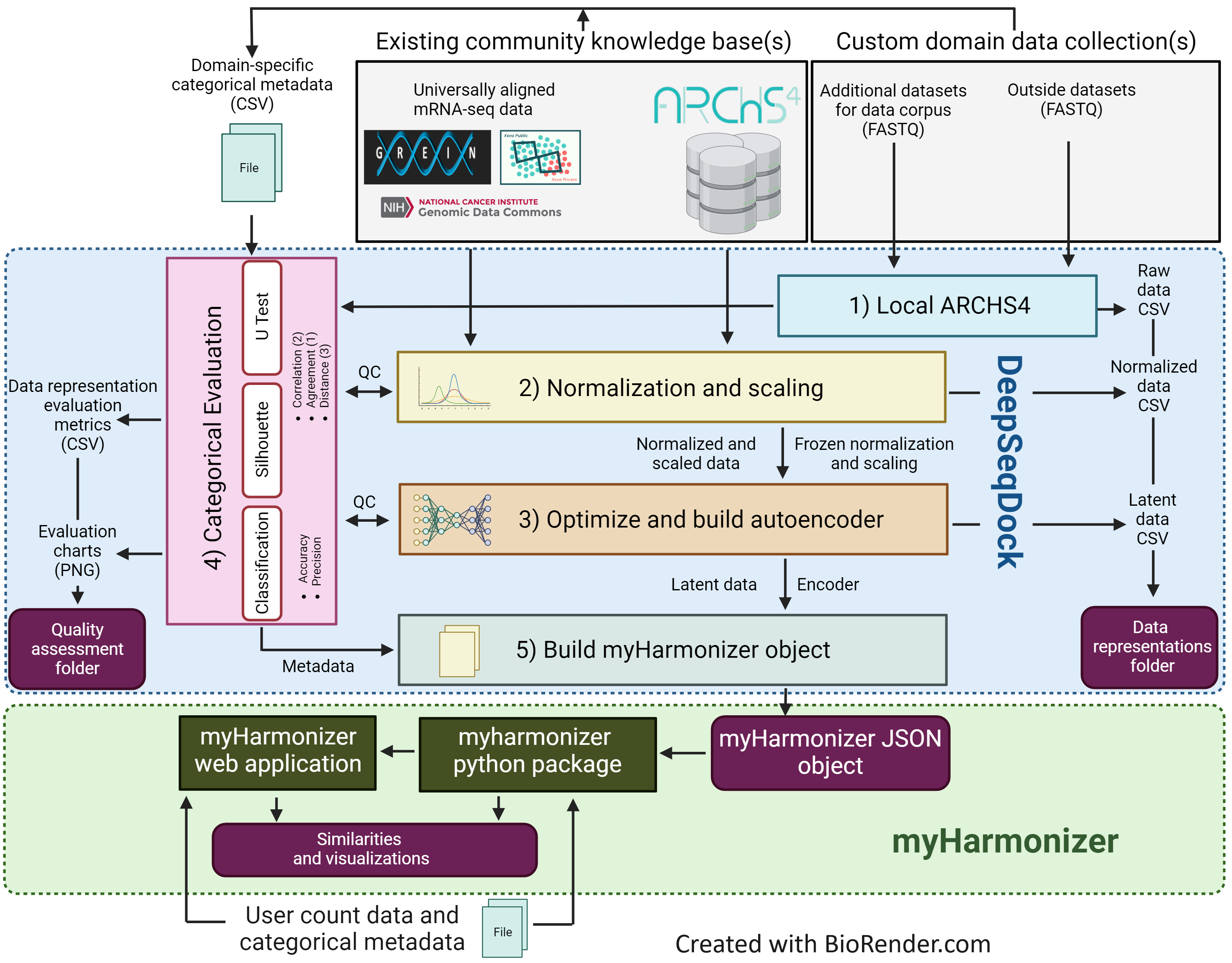
As with all deep learning approaches, the more clean data available, the stronger the model will be. The framework was tested on knowledge bases of hundreds to over a thousand datasets. This approach has not been validated for small knowledge bases (less than 100 samples).
Tag summary
Content type
Image
Digest
sha256:15615bc49…
Size
8.5 GB
Last updated
almost 2 years ago
docker pull bicbioenglab/deepseqdock