billsq/code-server-home-assistant
Forked from linuxserver/code-server, with Home Assistant plugins pre-configured.
301
billsq/code-server-home-assistant repository overview







The LinuxServer.io team brings you another container release featuring:
- regular and timely application updates
- easy user mappings (PGID, PUID)
- custom base image with s6 overlay
- weekly base OS updates with common layers across the entire LinuxServer.io ecosystem to minimise space usage, down time and bandwidth
- regular security updates
Find us at:
- Blog - all the things you can do with our containers including How-To guides, opinions and much more!
- Discord - realtime support / chat with the community and the team.
- Discourse - post on our community forum.
- Fleet - an online web interface which displays all of our maintained images.
- GitHub - view the source for all of our repositories.
- Open Collective - please consider helping us by either donating or contributing to our budget
linuxserver/code-server









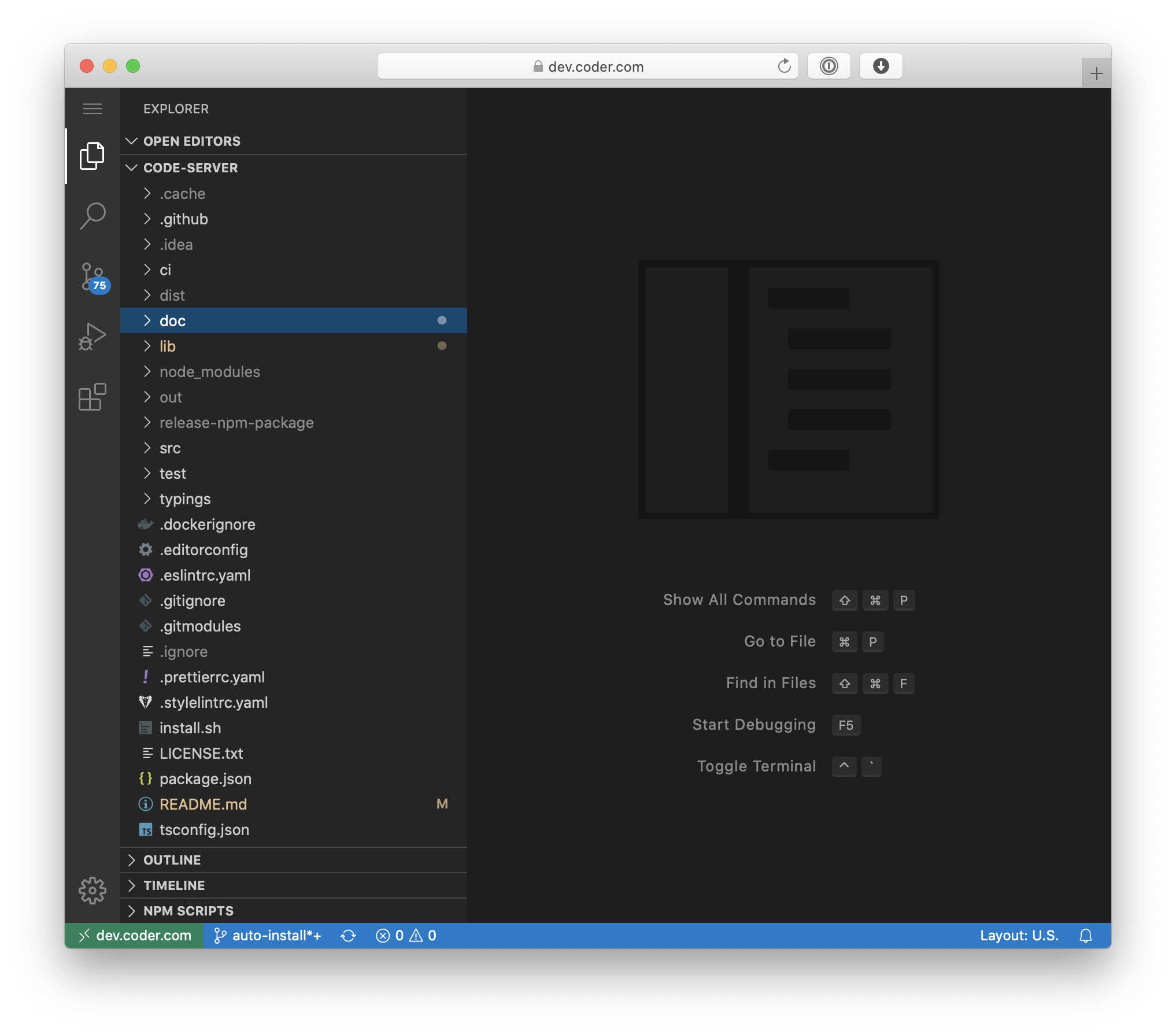
Code-server is VS Code running on a remote server, accessible through the browser.
- Code on your Chromebook, tablet, and laptop with a consistent dev environment.
- If you have a Windows or Mac workstation, more easily develop for Linux.
- Take advantage of large cloud servers to speed up tests, compilations, downloads, and more.
- Preserve battery life when you're on the go.
- All intensive computation runs on your server.
- You're no longer running excess instances of Chrome.
Supported Architectures
Our images support multiple architectures such as x86-64, arm64 and armhf. We utilise the docker manifest for multi-platform awareness. More information is available from docker here and our announcement here.
Simply pulling ghcr.io/linuxserver/code-server should retrieve the correct image for your arch, but you can also pull specific arch images via tags.
The architectures supported by this image are:
| Architecture | Tag |
|---|---|
| x86-64 | amd64-latest |
| arm64 | arm64v8-latest |
| armhf | arm32v7-latest |
Version Tags
This image provides various versions that are available via tags. latest tag usually provides the latest stable version. Others are considered under development and caution must be exercised when using them.
| Tag | Description |
|---|---|
| latest | Stable releases |
| development | DEPRECATED (no longer updated) - Prereleases from their GitHub |
Usage
Here are some example snippets to help you get started creating a container.
docker-compose (recommended)
Compatible with docker-compose v2 schemas.
---
version: "2.1"
services:
  code-server:
    image: ghcr.io/linuxserver/code-server
    container_name: code-server
    environment:
      - PUID=1000
      - PGID=1000
      - TZ=Europe/London
      - PASSWORD=password #optional
      - HASHED_PASSWORD= #optional
      - SUDO_PASSWORD=password #optional
      - SUDO_PASSWORD_HASH= #optional
      - PROXY_DOMAIN=code-server.my.domain #optional
    volumes:
      - /path/to/appdata/config:/config
    ports:
      - 8443:8443
    restart: unless-stopped
docker cli
docker run -d \
  --name=code-server \
  -e PUID=1000 \
  -e PGID=1000 \
  -e TZ=Europe/London \
  -e PASSWORD=password `#optional` \
  -e HASHED_PASSWORD= `#optional` \
  -e SUDO_PASSWORD=password `#optional` \
  -e SUDO_PASSWORD_HASH= `#optional` \
  -e PROXY_DOMAIN=code-server.my.domain `#optional` \
  -p 8443:8443 \
  -v /path/to/appdata/config:/config \
  --restart unless-stopped \
  ghcr.io/linuxserver/code-server
Parameters
Container images are configured using parameters passed at runtime (such as those above). These parameters are separated by a colon and indicate <external>:<internal> respectively. For example, -p 8080:80 would expose port 80 from inside the container to be accessible from the host's IP on port 8080 outside the container.
| Parameter | Function |
|---|---|
-p 8443 | web gui |
-e PUID=1000 | for UserID - see below for explanation |
-e PGID=1000 | for GroupID - see below for explanation |
-e TZ=Europe/London | Specify a timezone to use EG Europe/London |
-e PASSWORD=password | Optional web gui password, if PASSWORD or HASHED_PASSWORD is not provided, there will be no auth. |
-e HASHED_PASSWORD= | Optional web gui password, overrides PASSWORD, instructions on how to create it is below. |
-e SUDO_PASSWORD=password | If this optional variable is set, user will have sudo access in the code-server terminal with the specified password. |
-e SUDO_PASSWORD_HASH= | Optionally set sudo password via hash (takes priority over SUDO_PASSWORD var). Format is $type$salt$hashed. |
-e PROXY_DOMAIN=code-server.my.domain | If this optional variable is set, this domain will be proxied for subdomain proxying. See Documentation |
-v /config | Contains all relevant configuration files. |
Environment variables from files (Docker secrets)
You can set any environment variable from a file by using a special prepend FILE__.
As an example:
-e FILE__PASSWORD=/run/secrets/mysecretpassword
Will set the environment variable PASSWORD based on the contents of the /run/secrets/mysecretpassword file.
Umask for running applications
For all of our images we provide the ability to override the default umask settings for services started within the containers using the optional -e UMASK=022 setting.
Keep in mind umask is not chmod it subtracts from permissions based on it's value it does not add. Please read up here before asking for support.
User / Group Identifiers
When using volumes (-v flags) permissions issues can arise between the host OS and the container, we avoid this issue by allowing you to specify the user PUID and group PGID.
Ensure any volume directories on the host are owned by the same user you specify and any permissions issues will vanish like magic.
In this instance PUID=1000 and PGID=1000, to find yours use id user as below:
  $ id username
    uid=1000(dockeruser) gid=1000(dockergroup) groups=1000(dockergroup)
Application Setup
Access the webui at http://<your-ip>:8443.
For github integration, drop your ssh key in to /config/.ssh.
Then open a terminal from the top menu and set your github username and email via the following commands
git config --global user.name "username"
git config --global user.email "email address"
Hashed code-server password
How to create the hashed password.
Docker Mods


We publish various Docker Mods to enable additional functionality within the containers. The list of Mods available for this image (if any) as well as universal mods that can be applied to any one of our images can be accessed via the dynamic badges above.
Support Info
- Shell access whilst the container is running:
docker exec -it code-server /bin/bash - To monitor the logs of the container in realtime:
docker logs -f code-server - container version number
docker inspect -f '{{ index .Config.Labels "build_version" }}' code-server
- image version number
docker inspect -f '{{ index .Config.Labels "build_version" }}' ghcr.io/linuxserver/code-server
Updating Info
Most of our images are static, versioned, and require an image update and container recreation to update the app inside. With some exceptions (ie. nextcloud, plex), we do not recommend or support updating apps inside the container. Please consult the Application Setup section above to see if it is recommended for the image.
Below are the instructions for updating containers:
Via Docker Compose
- Update all images:
docker-compose pull- or update a single image:
docker-compose pull code-server
- or update a single image:
- Let compose update all containers as necessary:
docker-compose up -d- or update a single container:
docker-compose up -d code-server
- or update a single container:
- You can also remove the old dangling images:
docker image prune
Via Docker Run
- Update the image:
docker pull ghcr.io/linuxserver/code-server - Stop the running container:
docker stop code-server - Delete the container:
docker rm code-server - Recreate a new container with the same docker run parameters as instructed above (if mapped correctly to a host folder, your
/configfolder and settings will be preserved) - You can also remove the old dangling images:
docker image prune
Via Watchtower auto-updater (only use if you don't remember the original parameters)
- Pull the latest image at its tag and replace it with the same env variables in one run:
docker run --rm \ -v /var/run/docker.sock:/var/run/docker.sock \ containrrr/watchtower \ --run-once code-server - You can also remove the old dangling images:
docker image prune
Note: We do not endorse the use of Watchtower as a solution to automated updates of existing Docker containers. In fact we generally discourage automated updates. However, this is a useful tool for one-time manual updates of containers where you have forgotten the original parameters. In the long term, we highly recommend using Docker Compose.
Image Update Notifications - Diun (Docker Image Update Notifier)
- We recommend Diun for update notifications. Other tools that automatically update containers unattended are not recommended or supported.
Building locally
If you want to make local modifications to these images for development purposes or just to customize the logic:
git clone https://github.com/linuxserver/docker-code-server.git
cd docker-code-server
docker build \
  --no-cache \
  --pull \
  -t ghcr.io/linuxserver/code-server:latest .
The ARM variants can be built on x86_64 hardware using multiarch/qemu-user-static
docker run --rm --privileged multiarch/qemu-user-static:register --reset
Once registered you can define the dockerfile to use with -f Dockerfile.aarch64.
Versions
- 04.02.20: - Allow setting gui password via hash using env var
HASHED_PASSWORD. - 23.12.20: - Allow setting sudo password via hash using env var
SUDO_PASSWORD_HASH. - 29.05.20: - Add --domain-proxy support.
- 21.05.20: - Shrink images, install via yarn, fix arm32v7 build.
- 18.05.20: - Switch to multi-arch images, install via npm.
- 29.04.20: - Update start arguments.
- 01.04.20: - Structural changes required for v3.
- 17.01.20: - Fix artifact url retrieval from github.
- 24.10.19: - Upgrade to v2 builds.
- 28.09.19: - Update project logo.
- 21.09.19: - Add development builds/tag.
- 09.07.19: - Add optional sudo access.
- 01.07.19: - Add nano.
- 24.06.19: - Initial Release.
Tag summary
Content type
Image
Digest
Size
180.3 MB
Last updated
over 5 years ago
docker pull billsq/code-server-home-assistant