
bodyworkml/bodywork-core
Deploy machine learning projects developed in Python, to Kubernetes. Accelerate your MLOps 🚀
10K+
bodyworkml/bodywork-core repository overview




Bodywork deploys machine learning projects developed in Python, to Kubernetes. It helps you:
- serve models as microservices
- execute batch jobs
- run reproducible pipelines
On demand, or on a schedule. It automates repetitive DevOps tasks and frees machine learning engineers to focus on what they do best - solving data problems with machine learning.
Documentation
The documentation for bodywork-core can be found here. This is the best place to start.
Deployment Templates
To accelerate your project's journey to production, we provide deployment templates for common use-cases:
- batch scoring data
- deploying a model-scoring microservice with REST API
- scheduling a train-and-serve pipeline
Where does Bodywork Fit?
Bodywork is aimed at teams who want to deploy machine learning projects in containers. It will deliver your project's Python modules directly from your Git repository into Docker containers and manage their deployment to a Kubernetes cluster.
Where do I Install Bodywork?
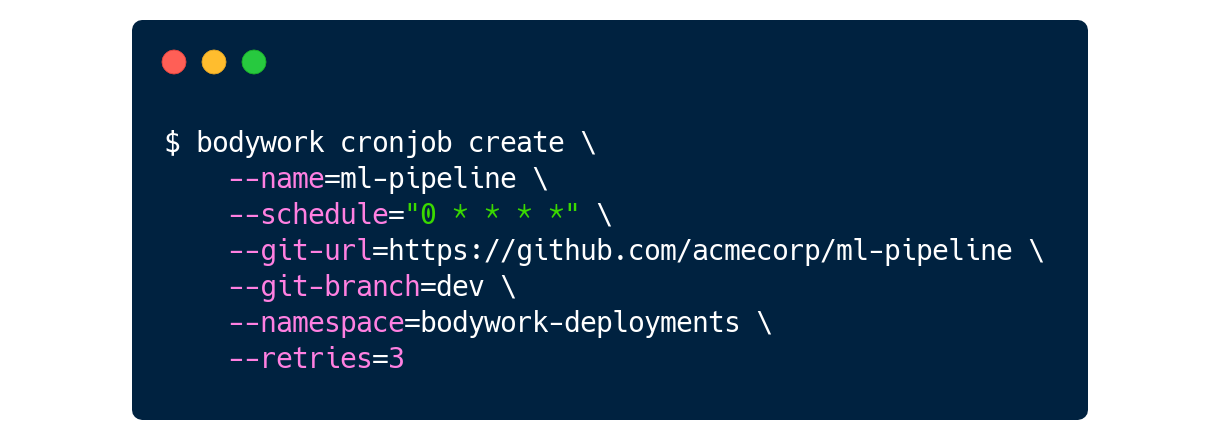
Bodywork is distributed as a Python package that exposes a command line interface for configuring Kubernetes to run Bodywork deployments. It takes just one command to schedule a pipeline hosted on GitHub to run every evening,
What does Bodywork Do?
When triggered, Bodywork clones your project's Git repository, analyses the configuration provided in a bodywork.yaml file, and then manages the deployment of the projects' stages - creating new Bodywork containers to run the Python modules that define each one. At no point is there any need to build Docker images, push them to a container registry or to configure Kubernetes directly.
This process is shown below for a train-and-serve pipeline with two stages: train model (as a batch job), then serve the trained model (as a microservice with a REST API).

What will I need to Do?
Divide your project into discrete stages and create an executable Python module for each one. Bundle these files together with a bodywork.yaml configuration file, into a Git repository and you're ready to go.

You do not need to tie yourself to new APIs - just add bodywork.yaml to your existing codebase and watch as Bodywork pulls each stage into its own container and deploys to Kubernetes.
CI/CD for Machine Learning
Because Bodywork can run deployments on a schedule, every time cloning the latest version of your codebase in the target branch, this system naturally forms an end-to-end CI/CD platform for your machine learning project, as illustrated below.

This is the GitOps pattern for cloud native continuous delivery.
Key Features
- continuous deployment - batch jobs, model-scoring services as well as complex ML pipelines, using pre-built Bodywork containers to orchestrate end-to-end machine learning workflows.
- resilience - Bodywork handles automatic retires for batch jobs and automatic roll-backs for service deployments, without any downtime.
- horizontal scaling - Bodywork can back your service endpoints with as many container replicas as you need to handle your API traffic volumes.
- no APIs to learn - Bodywork does not require you to re-write your machine learning projects to conform to our view of how your codebase should be engineered. All you need to do is provide executable Python modules for starting service applications and running batch jobs.
- multi-cloud - Bodywork deploys to Kubernetes clusters, which are available as managed services from all major cloud providers. Kubernetes is indifferent to where it is running, so changing cloud provider is as easy as pointing to a different cluster.
- written in Python - the native language of machine learning and data science, so your team can have full visibility of what Bodywork is doing and how.
- open-source - Bodywork is built and maintained by machine learning engineers, for machine learning engineers, who are committed to keeping it 100% open-source.
Bodywork brings DevOps to your machine learning projects and will form the basis of your Machine Learning Operations (MLOps) platform. It will ensure that your projects are always trained with the latest data, the most recent models are always deployed and your machine learning systems remain highly-available.
We want your Feedback
If Bodywork sounds like a useful tool, then please submit your feedback with a GitHub Star ★.
Before you get Started
Before you start exploring what Bodywork can do for you, you will need:
- access to a Kubernetes cluster - either locally using minikube or Docker-for-desktop, or as a managed service from a cloud provider, such as EKS on AWS or AKS on Azure.
- a GitHub account - support for GitLab, BitBucket and Azure DevOps will come later in 2021.
Familiarity with basic Kubernetes concepts and some exposure to the kubectl command-line tool will make life easier, but are not essential. If you would like to learn a bit more about Kubernetes, then we recommend the first two introductory sections of Marko Lukša's excellent book Kubernetes in Action, or the introductory article we wrote on Deploying Python ML Models with Flask, Docker and Kubernetes.
If you need help with any of this, then please don't hesitate to contact us and we'll do our best to get you up-and-running.
Contacting Us
If you:
- Have a question that these pages haven't answered, or need help getting started with Kubernetes, then please use our discussion board.
- Have found a bug, then please open an issue.
- Would like to contribute, then please talk to us first at [email protected].
- Would like to commission new functionality, then please contact us at [email protected].
Bodywork is brought to you by Bodywork Machine Learning.
Tag summary
Content type
Image
Digest
Size
386.1 MB
Last updated
over 4 years ago
docker pull bodyworkml/bodywork-core