ccharon/echoip repository overview
echoip



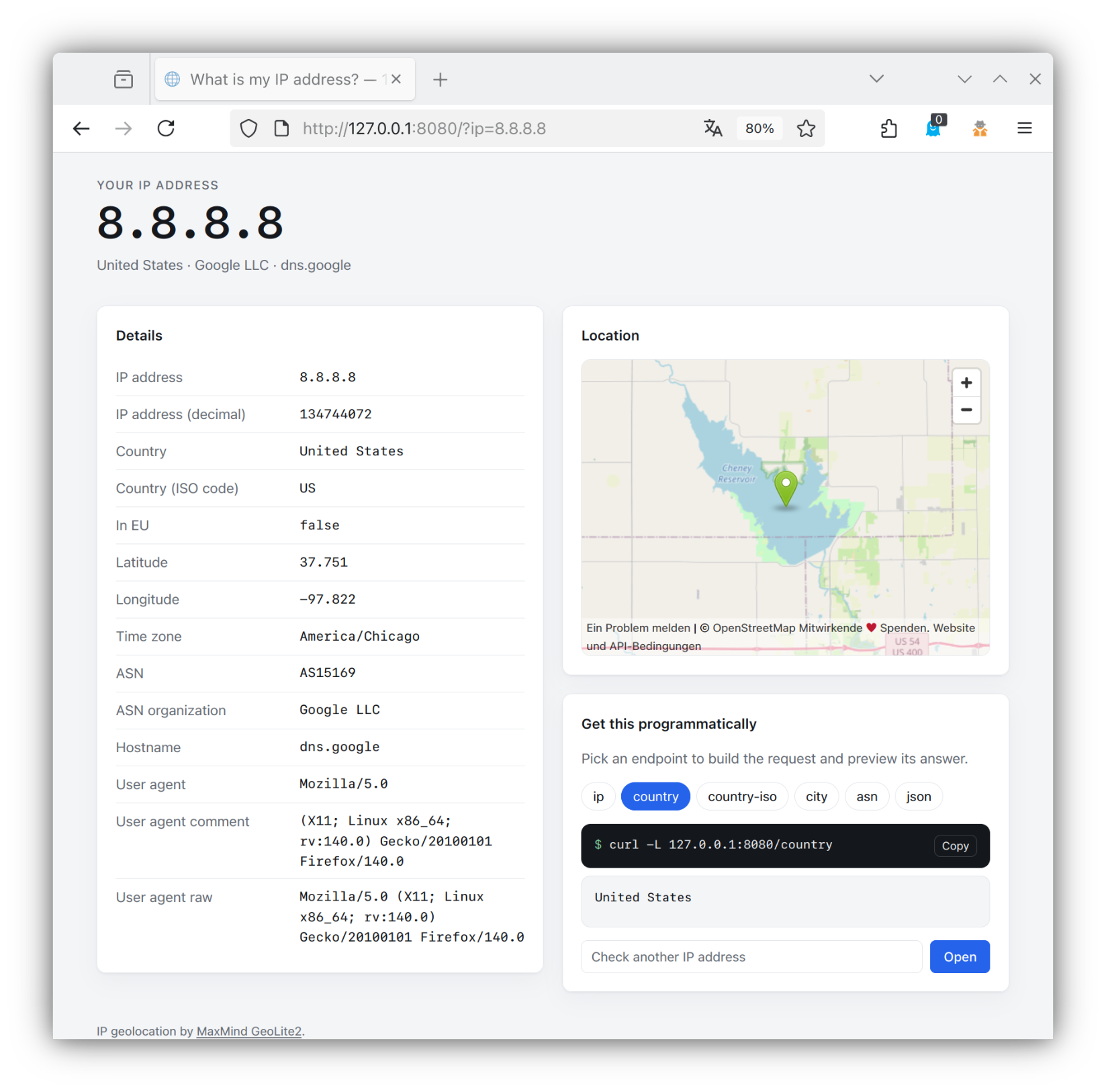
HTTP service that returns the caller's IP address, enriched with location and
ASN data from the MaxMind GeoLite2 databases. The response format follows the
Accept header and the user agent: plain text for CLI clients, JSON when
Accept weights application/json highest, an HTML page for browsers.
ccharon/echoip fork of leafcloudhq/echoip, which is a fork of mpolden/echoip.
unfortunately version 2.0 had a rough start, there are breaking changes in 2.0.1 and 2.0.2 due to the changed maxmind api and some hardening which led me to remove some cli parameters. Also the automatic db download requires MAXMIND_ACCOUNT_ID and GEOIP_LICENSE_KEY env vars. Details see below.
Run
The container downloads the GeoLite2 databases on first start and checks for new ones once a day. They live in a mounted volume, which keeps them across restarts and out of the image. This needs a MaxMind account, free after registration at maxmind.com. Both the account ID and a license key are required, because the download authenticates with them.
Put them in a .env file next to docker-compose.yml:
MAXMIND_ACCOUNT_ID=your-account-id
GEOIP_LICENSE_KEY=your-key
docker compose up -d
The first start downloads about 80 MB before the server accepts requests. The
server also runs without a database. It answers /, /ip and /json without
geo data, and the other endpoints answer 503 until their database is in
place.
services:
  echoip:
    # Pinned to a minor, so a pull cannot cross a major version.
    image: ccharon/echoip:2.0
    ports:
      - "127.0.0.1:8082:8080"
    environment:
      MAXMIND_ACCOUNT_ID: ${MAXMIND_ACCOUNT_ID:?set MAXMIND_ACCOUNT_ID in .env}
      GEOIP_LICENSE_KEY: ${GEOIP_LICENSE_KEY:?set GEOIP_LICENSE_KEY in .env}
    deploy:
      resources:
        limits:
          cpus: "0.10"
          memory: 256M
        reservations:
          cpus: "0.05"
          memory: 128M
    container_name: echoip
    restart: unless-stopped
    read_only: true
    cap_drop:
      - ALL
    security_opt:
      - no-new-privileges:true
    volumes:
      - geodata:/opt/echoip/data
    networks:
      - internal

volumes:
  geodata: {}

networks:
  internal: {}
The service speaks plain HTTP and belongs behind a proxy that terminates TLS, sets the trusted header and limits the request rate. A working configuration is in nginx.conf.
Endpoints
| Path | Answer |
|---|---|
/ | the address for a CLI client, the browser page otherwise |
/ip | the address |
/json | every field, also served on / for Accept: application/json |
/country, /country-iso | country name, ISO code |
/city, /coordinates | city, latitude and longitude |
/asn, /asn-org | AS number, AS organization |
/health | {"status":"OK"} |
$ curl echoip.example.com/country
Elbonia
$ curl echoip.example.com/json
{
  "ip": "203.0.113.9",
  "country": "Elbonia",
  "country_iso": "EB",
  "city": "Bornyasherk",
  "asn": "AS59795",
  "asn_org": "Hosting4Real"
}
?ip= answers for another address, which has to be a public one. Pass -4 or
-6 to the client to pick the address family.
A path that exists answers other methods with 405 and OPTIONS with 204,
both with an Allow header.
Errors
A failure comes in the format a success on the same request would have come
in. /json and /debug/cache/* answer with problem details after RFC 9457,
/ip and the field endpoints with one line of text, and / and unknown paths
negotiate like / does: JSON when Accept prefers it, text for a CLI client
or text/plain, the error page otherwise.
$ curl echoip.example.com/country?ip=10.0.0.5
error: 10.0.0.5 is not a public address and is not looked up.
$ curl echoip.example.com/json?ip=10.0.0.5
{
  "type": "https://github.com/ccharon/echoip#not-public-address",
  "title": "Address is not public",
  "status": 400,
  "detail": "10.0.0.5 is not a public address and is not looked up."
}
type names the kind of failure and links to its entry below. title is fixed
per type, detail describes the case at hand.
invalid-address
400. The address in ?ip= or in a trusted header is not an IP address.
not-public-address
400. The address is private, reserved or loopback, and is not looked up.
invalid-capacity
400. The body of POST /debug/cache/resize is not a whole number of at
least 0.
not-found
404. No endpoint answers at the path. The field endpoints of a database that
is not configured with -c or -a are absent as well.
method-not-allowed
405. The path exists for other methods, which Allow names.
database-unavailable
503. The database the endpoint needs is configured and not loaded yet.
Retry-After names the seconds until the updater tries again. It is left
out with -u 0, where no updater runs, and while a check is running.
internal
500. The request could not be completed. The cause is in the log only.
Configure
| Name | Type | Default | Effect |
|---|---|---|---|
MAXMIND_ACCOUNT_ID | environment | none | MaxMind account ID. Required when a database is configured and -u is not 0, otherwise the server exits on start. |
GEOIP_LICENSE_KEY | environment | none | MaxMind license key. Required alongside the account ID. |
-a | string | none | Path to the GeoIP ASN database |
-c | string | none | Path to the GeoIP city database |
-u | int | 24 | Hours between checks for new databases. 0 disables checking, and then no credentials are needed. |
-l | string | :8080 | Listening address. An empty host listens on all interfaces, IPv4 and IPv6. 0.0.0.0:8080 is IPv4 only, 127.0.0.1:8080 is loopback only. |
-H | string, repeatable | none | Header to trust for the remote IP, e.g. X-Real-IP |
-T | string, repeatable | any peer | Networks whose requests may set the headers from -H, e.g. 10.0.0.0/8 or a single address |
-r | bool | false | Perform reverse hostname lookups |
-C | int | 0 | Number of responses to cache. The entry read longest ago is dropped when it is full. 0 disables caching. |
-P | bool | false | Register the pprof and cache handlers below /debug |
-V prints the version and exits. The image sets -c, -a, -r, -C 1000
and -H X-Real-IP in its ENTRYPOINT, so the table describes the binary.
-c and -a also tell the updater where to write. The credentials are read
from the environment rather than from flags, because flags are visible in the
process list. They are sent as HTTP basic auth, so no URL carries them.
-u counts whole hours. MaxMind rebuilds GeoLite2 twice a week and limits
downloads per day, so a finer interval buys nothing and a coarser one such as
48 costs little.
-u 0 leaves the database files to whoever put them there, which is what
make geoip-download or a volume filled from outside does.
-T takes CIDR notation or a single address. A network with host bits set is
refused rather than widened, so -T 10.1.2.3/8 exits and names 10.0.0.0/8.
Security
The service answers unauthenticated requests from anyone.
| Measure | Effect |
|---|---|
| The service opens no outbound connections | It answers from the GeoIP databases only, so a caller cannot make it reach an address of their choosing. |
| Only public addresses are looked up | An address from ?ip= or from a trusted header is refused with 400 unless it is globally reachable. The address the connection came from is always answered for. |
| Security headers on every response | Content-Security-Policy, X-Content-Type-Options: nosniff, Referrer-Policy: no-referrer, X-Frame-Options: DENY, Cache-Control: no-store. |
| Content Security Policy by hash | Inline script and style are allowed by their SHA-256 hash rather than by unsafe-inline. |
| Database downloads are verified | Each archive is checked against the SHA-256 checksum MaxMind publishes for it. |
| Requests are bounded | Headers are refused at 12 KiB, the body of /debug/cache/resize at 32 bytes, and an error quotes at most 128 characters of what the caller sent. |
| The container runs as an unprivileged user | UID 65532, with a read-only root filesystem, no capabilities and no-new-privileges. |
| The credentials never reach a log | They are read from the environment and sent in an Authorization header, and errors are stripped of the request URL. |
| Refused requests are logged | Every 4xx and 5xx is written as a key=value line with the peer address, the address a trusted proxy reported, the method, the target and the reason. Values are quoted where needed and cut at 128 characters. |
Set -H only for headers the proxy overwrites, otherwise a caller picks the
address they are shown data for. -T narrows that to the networks the proxy
connects from.
-P registers handlers below /debug that are unauthenticated.
/debug/pprof/heap hands out memory contents, which include the credentials.
Keep the listening address unreachable from the internet while they are on.
Limitations
- The refresh runs in process. A container that is restarted more often than the refresh interval downloads the databases again whenever the volume is empty.
- A failed check is logged and retried twice, 30 minutes apart. After that the next check follows the refresh interval. The previously downloaded databases stay in use.
- A database that is damaged after it was written is not downloaded again,
because the conditional request still answers
304. Every failed lookup is logged, so delete the file to force a download. SIGTERMandSIGINTstop the listener and give running requests up to 10 seconds to finish.- The image carries the CA bundle of the build stage. A root that expires or a certificate chain that changes after the build breaks the MaxMind download until the image is rebuilt.
License
BSD 3-Clause, see LICENSE. Copyright is held by Martin Polden for the original work and by Christian Charon for the changes in this fork.
This product includes GeoLite2 data created by MaxMind, available from maxmind.com. The databases are subject to the GeoLite2 End User License Agreement and are not distributed with this repository or its image.
Tag summary
Content type
Image
Digest
sha256:6550459d2…
Size
8.7 MB
Last updated
30 days ago
docker pull ccharon/echoip