Sign inSign up

drumsergio/cashpilot

By drumsergio

•Updated about 17 hours ago

Image
0

10K+

drumsergio/cashpilot repository overview

CashPilot

Docker Pulls GitHub Stars License: GPL-3.0 Tests codecov


⁠What is CashPilot?

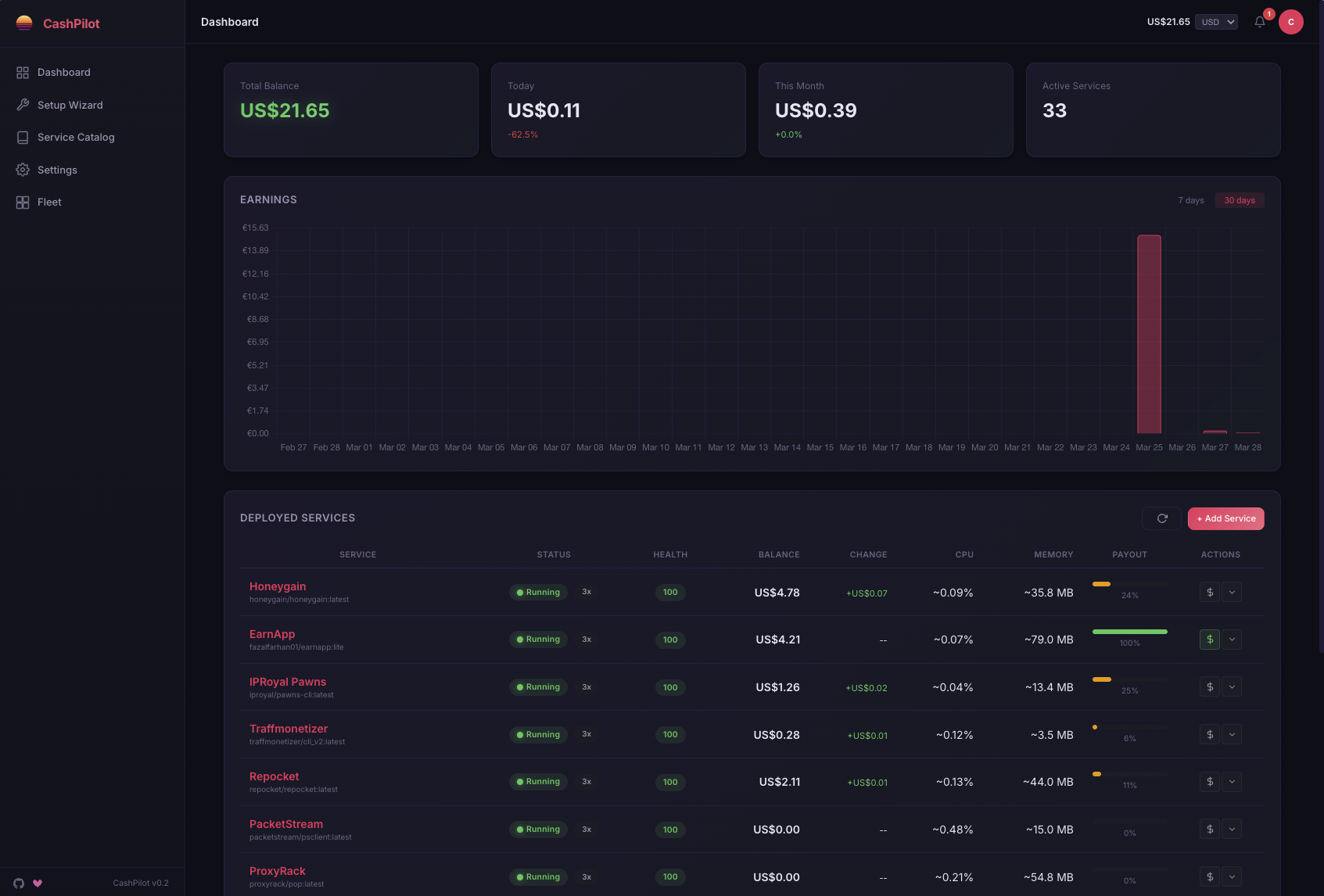
CashPilot is a self-hosted platform that lets you deploy, manage, and monitor passive income services from a single web interface. Instead of manually setting up dozens of Docker containers, configuring credentials, and checking multiple dashboards, CashPilot handles everything from one place.

It supports both Docker-based services (deployed and managed automatically) and browser extension / desktop-only services (tracked via the web UI with signup links, earning estimates, and balance monitoring). Whether a service runs in a container or in your browser, CashPilot aggregates all your earnings into a unified dashboard with historical tracking.

The key differentiator: a browser-based setup wizard guides you through account creation and service deployment, orchestrates containers through Docker workers, and collects earnings from 40+ services across bandwidth sharing, DePIN, storage, and GPU compute categories.

Dashboard

⁠Features

  • Web-based setup wizard with guided account creation for each service
  • One-click container deployment for 16+ passive income services
  • Real-time earnings dashboard with historical charts and trend analysis
  • Container health monitoring -- CPU, memory, network, and uptime at a glance
  • Multi-category support -- bandwidth sharing, DePIN, storage sharing, GPU compute
  • Automatic earnings collection from service APIs and dashboards
  • Mobile-responsive dark UI -- manage your fleet from any device
  • Simple two-container setup -- UI + Worker, no dependencies to install
  • Runs on x86-64 and ARM -- Raspberry Pi, Apple Silicon and ARM cloud boxes; see Running on ARM⁠
  • Service catalog with earning estimates, requirements, and platform details

Every setting, and which source wins: Configuration reference⁠

Upgrading an existing install? Read UPGRADING.md⁠ first. It lists only the releases that need you to do something.

⁠Quick Start

With Docker Compose (recommended):

docker compose up -d
# Open http://localhost:8080

This starts two containers:

  • cashpilot-ui -- Web dashboard, earnings collection, service catalog (port 8080)
  • cashpilot-worker -- Docker agent that deploys and monitors service containers (port 8081, requires Docker socket)

Then open http://localhost:8080⁠ and follow the setup wizard. On first start, CashPilot prints a one-time setup token to the cashpilot-ui container logs (docker compose logs cashpilot-ui) — enter it on the registration form to create the first (owner) account. See Getting Started⁠ for details.

Security — network exposure. By default the dashboard is published on loopback only (127.0.0.1:8080), because it can command the Docker-socket worker. To reach it from another machine, set CASHPILOT_BIND_ADDR to a specific interface (e.g. a Tailscale/VPN IP) or, preferably, run an authenticating reverse proxy in front. Never publish the worker's port (8081) on a public interface — it exposes a Docker-socket API equivalent to root on the host.

Note: The worker container requires access to the Docker socket (/var/run/docker.sock) to deploy and manage service containers. Both containers are required for full functionality.

⁠Supported Services

⁠Docker-Deployable Services

Services CashPilot can deploy and manage automatically via Docker.

ServiceGuideResidential IP requiredVPS allowedDevices / AcctDevices / IPPayout
Anyone Protocol⁠Guide⁠❌✅? ***? ***Crypto
Bitping⁠Guide⁠❌✅? ***? ***Crypto (SOL)
Earn.fm⁠Guide⁠✅✅? ***1Crypto
EarnApp⁠ ****Guide⁠✅❌15? ***PayPal, Amazon Gift Card, Wise
Honeygain⁠Guide⁠✅❌101PayPal, Crypto
IPRoyal Pawns⁠Guide⁠✅❌? ***1PayPal, Crypto, Bank Transfer
MystNodes⁠Guide⁠❌✅? ***UnlimitedCrypto
PacketStream⁠Guide⁠✅❌? ***? ***PayPal
ProxyBase⁠Guide⁠❌✅? ***? ***Crypto
ProxyBase Markets⁠Guide⁠❌✅? ***? ***Crypto (USDC)
ProxyLite⁠Guide⁠❌✅? ***? ***Crypto, PayPal
ProxyRack⁠Guide⁠❌✅500? ***PayPal, Crypto
Repocket⁠Guide⁠✅❌5? ***PayPal, Crypto
Storj⁠Guide⁠❌✅? ***? ***Crypto (USDC)
Traffmonetizer⁠Guide⁠❌✅? ***UnlimitedCrypto (USDT), PayPal
URnetwork⁠Guide⁠❌✅? ***? ***Crypto

* Storj nodes on the same /24 subnet share data allocation, reducing per-node earnings.

** Traffmonetizer ToS requires residential IP, but VPS nodes are accepted in practice.

**** EarnApp's help centre prohibits Docker containers, VMs, hosting services and home servers, with account termination and cancellation of pending payments as the stated penalty — which is exactly how CashPilot deploys it. Read the guide⁠ before deploying.

*** ? means the catalog does not record this, so nobody has verified it against the provider. It is not a synonym for "no limit" — see per-IP device limits⁠ for the values that are sourced. A number widely repeated on review sites is not a source.

These tables are generated from the service YAML by scripts/generate_readme_tables.py and checked in CI, so they cannot drift from the catalog. Edit the YAML, not the table.

⁠Browser Extension / Desktop Only

These services have no Docker image. CashPilot lists them in the catalog with signup links and earning estimates, but cannot deploy or monitor them.

ServiceGuideResidential IP requiredVPS allowedDevices / AcctDevices / IPPayoutStatus
Bytebenefit⁠Guide⁠✅❌? ***? ***PayPalActive
Bytelixir⁠Guide⁠✅❌? ***? ***CryptoActive
Dawn Internet⁠Guide⁠✅❌? ***? ***CryptoActive
Deeper Network⁠Guide⁠✅❌? ***? ***CryptoActive
Ebesucher⁠Guide⁠✅❌? ***1PayPalActive
Gradient Network⁠Guide⁠✅❌? ***? ***CryptoActive
Grass⁠Guide⁠✅❌? ***? ***CryptoActive
Helium⁠Guide⁠✅❌? ***? ***CryptoActive
Nodepay⁠Guide⁠✅❌? ***? ***CryptoActive
Nodle⁠Guide⁠❌✅? ***? ***CryptoActive
PassiveApp⁠Guide⁠✅❌? ***? ***Crypto, PayPalActive
Sentinel dVPN⁠Guide⁠❌✅? ***? ***CryptoActive
Spide⁠Guide⁠✅❌? ***1CryptoActive
Teneo Protocol⁠Guide⁠✅❌? ***? ***CryptoActive
Theta Edge Node⁠Guide⁠❌✅? ***? ***CryptoActive
Titan Network⁠Guide⁠✅❌? ***? ***CryptoActive
Uprock⁠Guide⁠✅❌? ***? ***CryptoActive
⁠GPU Compute

GPU-intensive computing services. Requires compatible hardware.

ServiceGuideResidential IP requiredGPUMin StoragePayoutStatus
Flux⁠Guide⁠❌❌220GBCryptoActive
Golem Network⁠Guide⁠❌❌20GBCryptoActive
io.net⁠Guide⁠❌✅N/ACryptoActive
Nosana⁠Guide⁠❌✅50GBCryptoActive
Salad⁠Guide⁠✅✅N/APayPal, Gift CardsActive
Vast.ai⁠Guide⁠❌✅100GBCrypto, Bank TransferActive

Note: Earnings vary widely by location, hardware, and demand -- see individual guide pages in docs/guides/ for details.

⁠How It Works

  1. Deploy CashPilot -- a single docker compose up -d gets you running
  2. Open the web UI -- browse the full service catalog at http://localhost:8080
  3. Browse services -- filter by category, see earning estimates and requirements
  4. Sign up -- each service card has a signup link; create accounts as needed
  5. Enter your credentials -- the setup wizard collects only what each service needs
  6. CashPilot deploys and monitors -- the worker launches containers, health-checks them, and the UI tracks earnings automatically

⁠Architecture

CashPilot uses a split UI + Worker architecture:

  • UI container (drumsergio/cashpilot) -- FastAPI web application with dashboard, earnings collection, service catalog, and credential storage. No Docker socket needed.
  • Worker container (drumsergio/cashpilot-worker) -- Agent with Docker socket access that deploys, monitors, and manages service containers. Reports status to the UI via API.
  • Database: SQLite -- zero configuration, backed up via the mounted volume
  • Service definitions: YAML files in services/ are the single source of truth for all service metadata, Docker configuration, and earning estimates
  • Frontend: Server-rendered templates with a responsive dark UI
cashpilot/
  app/            # FastAPI application (UI + worker API)
  services/       # YAML service definitions (source of truth)
    bandwidth/    # Bandwidth sharing services
    depin/        # DePIN services
    storage/      # Storage sharing services
    compute/      # GPU compute services
  docs/           # Documentation and guides

⁠Configuration

⁠UI Environment Variables
VariableDefaultDescription
TZUTCTimezone for scheduling and display
CASHPILOT_SECRET_KEY(auto-generated)Signing key for login sessions. Persisted at /data/.secret_key. Does not encrypt credentials
CASHPILOT_ENCRYPTION_KEY(auto-generated)Fernet key encrypting stored credentials at rest. Persisted at /data/.fernet_key. Set this only to restore a backup — see Backing up the encryption key⁠
CASHPILOT_ALLOW_EPHEMERAL_KEYfalseAllow startup when the encryption key cannot be written to disk. Credentials are then lost on restart, so this is off by default
CASHPILOT_API_KEY--Enrollment/bootstrap key; each worker then gets its own key (per-worker fleet keys, v1.0.0+)
CASHPILOT_COLLECT_INTERVAL60Minutes between earnings collection cycles
CASHPILOT_METRICS_ENABLEDfalseSet to true to expose Prometheus metrics at /metrics
CASHPILOT_BIND_ADDR127.0.0.1Host interface the UI port is published on. Loopback by default; set a specific IP (e.g. a VPN address) or 0.0.0.0 to expose it — prefer a reverse proxy with auth

The UI's web port inside the container is fixed at 8080 (set via the container's CMD); CASHPILOT_BIND_ADDR controls only which host interface it is published on.

⁠Worker Environment Variables
VariableDefaultDescription
TZUTCTimezone
CASHPILOT_UI_URL--URL of the UI container, e.g. http://cashpilot-ui:8080
CASHPILOT_API_KEY--Must match the UI's API key
CASHPILOT_WORKER_NAME(hostname)Display name for this worker in the fleet dashboard
CASHPILOT_WORKER_URL(auto-detected)URL the UI uses to reach this worker, e.g. http://192.168.10.50:8081. Set explicitly for remote/cross-host workers
CASHPILOT_WORKER_BIND_ADDR127.0.0.1Host interface the worker's Docker-socket API port is published on. Loopback by default — for a remote worker set a private/VPN interface, never a public IP
CASHPILOT_PORT8081Port the worker advertises to the UI. It does not change the listen port, which is fixed by the image's CMD — see the configuration reference⁠
CASHPILOT_WORKER_NETWORK(detected)residential or hosting. Overrides the hardware-based guess used to warn about residential-only services
CASHPILOT_EGRESS_DETECTonSet to off to stop this worker looking up its own public IP (see below)
CASHPILOT_EGRESS_IP--State this worker's public IP directly instead of looking it up. Must be a public address
CASHPILOT_EGRESS_IP_URL--Use your own IP-echo endpoint (returning a bare IP) instead of the public ones. Used exclusively — no fallback
⁠Why the worker looks up its public IP

Bandwidth providers cap earnings per IP address, not per machine. Two workers behind one home connection are two rows on your dashboard and one customer to the provider, so the second one usually earns nothing. To warn you before that happens, each worker asks a public IP-echo service what address it comes from — one request per hour.

That is the only outbound call CashPilot makes purely to learn about your setup. Turn it off with CASHPILOT_EGRESS_DETECT=off, point it at your own endpoint with CASHPILOT_EGRESS_IP_URL, or skip the lookup entirely by stating the address with CASHPILOT_EGRESS_IP. With detection off, the fleet simply reports that worker's exit as undetermined and raises no conflict warnings for it.

Known limitation: grouping matches on the exact address, so on a native-IPv6 connection each machine has its own global address and no conflict is detected. The check is therefore best-effort — it can miss a conflict, but it will not invent one.

⁠Multi-Node Fleet Management

For power users running services across multiple servers, deploy a single CashPilot UI and connect workers from each server. The UI aggregates everything into a unified fleet view; workers report via HTTP API.

CashPilot UI (dashboard + earnings + catalog)
        ^                ^                ^
        | HTTP           | HTTP           | HTTP
  Worker (server-a)  Worker (server-b)  Worker (server-n)
  + Docker socket    + Docker socket    + Docker socket
⁠Setting up the fleet

Use docker-compose.fleet.yml on your main server to run both the UI and a local worker:

docker compose -f docker-compose.fleet.yml up -d
⁠Adding remote workers

On each additional server, deploy only a worker pointing to the UI:

services:
  cashpilot-worker:
    image: drumsergio/cashpilot-worker:1.19
    pull_policy: always
    container_name: cashpilot-worker
    ports:
      # The worker's API is backed by the Docker socket -- deploy, stop or
      # remove ANY container -- so publishing it is publishing full control of
      # this host. It binds LOOPBACK by default for that reason.
      #
      # A remote UI does need to reach it, so set CASHPILOT_WORKER_BIND_ADDR to
      # this server's PRIVATE or VPN address (a Tailscale IP, say). Never a
      # public one, and never 0.0.0.0.
      - "${CASHPILOT_WORKER_BIND_ADDR:-127.0.0.1}:8081:8081"
    volumes:
      - /var/run/docker.sock:/var/run/docker.sock
      - cashpilot_worker_data:/data
    environment:
      - TZ=Europe/Madrid
      - CASHPILOT_UI_URL=http://main-server:8080
      - CASHPILOT_API_KEY=your-shared-api-key
      - CASHPILOT_WORKER_NAME=server-b
      - CASHPILOT_WORKER_URL=http://server-b:8081
    restart: unless-stopped
    security_opt:
      - no-new-privileges:true

volumes:
  cashpilot_worker_data:

Communication goes both ways: workers connect outbound to the UI via HTTP for heartbeats, and the UI connects outbound to each worker's :8081 API to push commands (deploy, stop, restart). This means the worker must be reachable from the UI (LAN, Tailscale, or port forwarding) -- set CASHPILOT_WORKER_URL to the address the UI should use, since auto-detection falls back to the container's own network interface, which is often unreachable from another host. The UI's fleet dashboard shows all connected workers, their containers, and live status.

⁠FAQ

Is bandwidth sharing safe?

Bandwidth sharing services generally route legitimate traffic (market research, ad verification, price comparison, content delivery) through your connection. That said, you are sharing your IP address, so review each service's terms of service and privacy policy carefully before signing up. Running these on a VPS rather than residential IP is an option for some services. This is not legal advice -- consult with the particular services you intend to use and, if needed, seek independent legal counsel regarding your jurisdiction.

How much can I earn?

Earnings vary widely based on location, ISP, number of devices, and which services you run. The dashboard tracks your actual earnings over time so you can optimize your setup.

Can I run on a VPS or cloud server?

Some services require a residential IP and will not pay (or will ban) VPS/datacenter IPs. These are marked as "Residential Only" in the service catalog. Services that work on VPS are a good way to scale up without additional home hardware.

How are credentials stored?

All service credentials are encrypted at rest in the SQLite database using a Fernet key stored at /data/.fernet_key, which is generated automatically on first run. The database file lives in the mounted Docker volume (cashpilot_data:/data). No credentials are ever sent anywhere except to the service containers themselves.

Note that this is a different key from CASHPILOT_SECRET_KEY, which only signs login sessions.

⁠Backing up the encryption key

Your credentials are only as recoverable as /data/.fernet_key. If you lose that file you will have to re-enter every credential, because there is no way to decrypt the stored values without it.

# Back it up
docker exec cashpilot-ui cat /data/.fernet_key

# Restore onto a fresh volume: pass the saved value when starting CashPilot.
# It must reach the container, so put it on the same command line (or export it,
# or set it in your .env) - a bare shell assignment on its own line does nothing.
CASHPILOT_ENCRYPTION_KEY=<the value you saved> docker compose up -d

The file always takes precedence over the environment variable, so setting CASHPILOT_ENCRYPTION_KEY on an instance that already has a key changes nothing and is safe. It is adopted only when no key file exists, which is exactly the restore case.

If the key cannot be written to disk at all — an unwritable or unmounted /data — CashPilot refuses to start rather than encrypting your credentials under a key that disappears on the next restart. Set CASHPILOT_ALLOW_EPHEMERAL_KEY=true if that is genuinely what you want.

What about security?

Every service CashPilot deploys runs in its own container with every Linux capability dropped (a few services add back only the ones they declare) and --security-opt no-new-privileges set, so a process inside cannot gain privileges. Containers cannot see your host filesystem beyond the volumes a service declares. They CAN reach your local network by default, because Docker does not block that; Protecting Your Home Network⁠ shows how to put them on a firewalled bridge that reaches the internet but not your LAN, router or host. That bridge does not cover a service on host networking (Mysterium, today); the guide says what to do about those. Service credentials are encrypted at rest using Fernet symmetric encryption. Only the worker container requires Docker socket access; the UI container has no privileged access.

That said, no setup is bulletproof. You are still running third-party software that routes external traffic through your network. Docker isolation significantly reduces the attack surface compared to running these services directly on your host, but it does not eliminate all risk. We recommend running CashPilot on a dedicated machine or VLAN, keeping Docker and your host OS up to date, and reviewing the open-source code of any service before deploying it.

What happens if a service container crashes?

CashPilot monitors container health continuously. If a service container exits unexpectedly, it is automatically restarted. The dashboard shows uptime and health status for every running service.

⁠Disclosure

The signup links in CashPilot and in this README are referral links. If you sign up through one, the maintainer may earn a commission, at no cost to you, which helps fund CashPilot's development. To avoid them, sign up on the provider's own website instead.

⁠Ecosystem

ProjectTypeDescription
CashPilot-android⁠Android AgentMonitoring agent for passive income apps running on Android devices
cashpilot-mcp⁠MCP ServerMonitor earnings from AI assistants via the Model Context Protocol
cashpilot-ha⁠Home Assistant IntegrationEarnings and service status sensors for

Tag summary

Content type

Image

Digest

sha256:dbf8706b5…

Size

32.4 MB

Last updated

about 17 hours ago

docker pull drumsergio/cashpilot