hteppl/remnawave-subpage-proxy
Live templates, conditions and host shuffling for Remnawave (https://docs.rw) subscriptions.
1.3K
hteppl/remnawave-subpage-proxy repository overview
remnawave-subpage-proxy





English | Русский
An announce is defined in the panel or in the proxy configuration:
Used {TRAFFIC_USED} of {TRAFFIC_LIMIT} · {DAYS_LEFT} days left
Every client receives it with the values resolved:
Used 10.50 GB of 100.00 GB · 12 days left
Features
- Fallback Cache - Optionally replays the last good subscription while Remnawave is unreachable
- Force Unlimited - Optionally reports every plan as unlimited, whatever quota the panel holds
- Scanner Blocking - Probes for
/.env,/.gitand the like are refused before they reach the panel - Broken User-Agent Notice - A link or JSON pasted as the User-Agent gets a message instead of the servers
- Rich Placeholders - Formatted dates,
∞for unlimited plans, percentages, a progress bar and modifiers on top of the panel's own{{VAR}}templates - Conditional Rules - Templated text per client type, user agent, user status or quota
- Host Shuffling - Optionally shuffles the servers matching a name pattern, each group within its own positions
- Zero-Cost Placeholders - Traffic and expiry come from the response headers, so the common case makes no API call
- Transparent Proxy - Header casing, the real client IP and drop-on-error all preserved
- Docker Ready - Multi-arch image, non-root, read-only, self-probing healthcheck
Compared with Remnawave
Since Remnawave 3.0 the announce, profile title, support link and routing are
plain Custom Response Headers, and the panel resolves its own {{VAR}}
templates in them. A static announce such as Used {{TRAFFIC_USED}} of {{TOTAL_TRAFFIC}} therefore needs no proxy. The proxy covers what the panel
does not:
| Feature | Remnawave | Proxy |
|---|---|---|
| Templated custom response headers | {{VAR}}, 22 variables | {VAR}, more variables and modifiers |
| Formatted expiry date | — (only {{EXPIRE_UNIX}}) | {EXPIRES_AT}, {EXPIRES_AT_DATE}, {EXPIRES_AT_TIME} |
| Unlimited plan in text | {{TRAFFIC_LEFT}} renders 0 | ∞, configurable |
| Percentages, progress bar, modifiers | — | {TRAFFIC_USED_PERCENT}, {PROGRESS_BAR}, |truncate |
| Base64 header values | rwEncodeBase64: prefix | encode: base64 / base64-prefixed |
| Length limit after rendering | — | max_length |
| Headers by user agent / client | Response Rules, static values only | when: user_agent, client_types, templated |
| Headers by user status or quota | — ({{STATUS:EXPIRED=…}} labels only) | when: user_statuses, has_traffic_limit |
| Remarks for expired / limited users | Custom Remarks | — (use the panel) |
| Host shuffling | randomizeHosts; per-host flag moves hosts to the top | By client-visible name, positions kept |
| Fallback cache during a panel outage | — (the connection is dropped) | SUBSCRIPTION_CACHE_ENABLED |
| Force unlimited in the app's readout | — | traffic.force_unlimited |
| Scanner probe blocking | — (probes are looked up in the panel) | block: |
| Broken User-Agent handling | Response Rules can block, without templated text | user_agents:, templated message hosts |
| Header name casing | Lowercased by the subscription page | Preserved |
Both template layers can be combined in one header: the panel resolves
{{VAR}} before the response reaches the proxy, which then resolves {VAR}.
The syntaxes never collide.
Prerequisites
Docker and Docker Compose, a Remnawave panel with a subscription page, and an API token from Remnawave Settings → API Tokens. The subscription page is bundled in the compose file if it is not already running.
How it works
The proxy sits in front of the official subscription page and rewrites response headers. The page is left unmodified: the web interface, browser detection, client-type templates, Marzban legacy links and subpage configurations keep working, and upstream updates still apply.
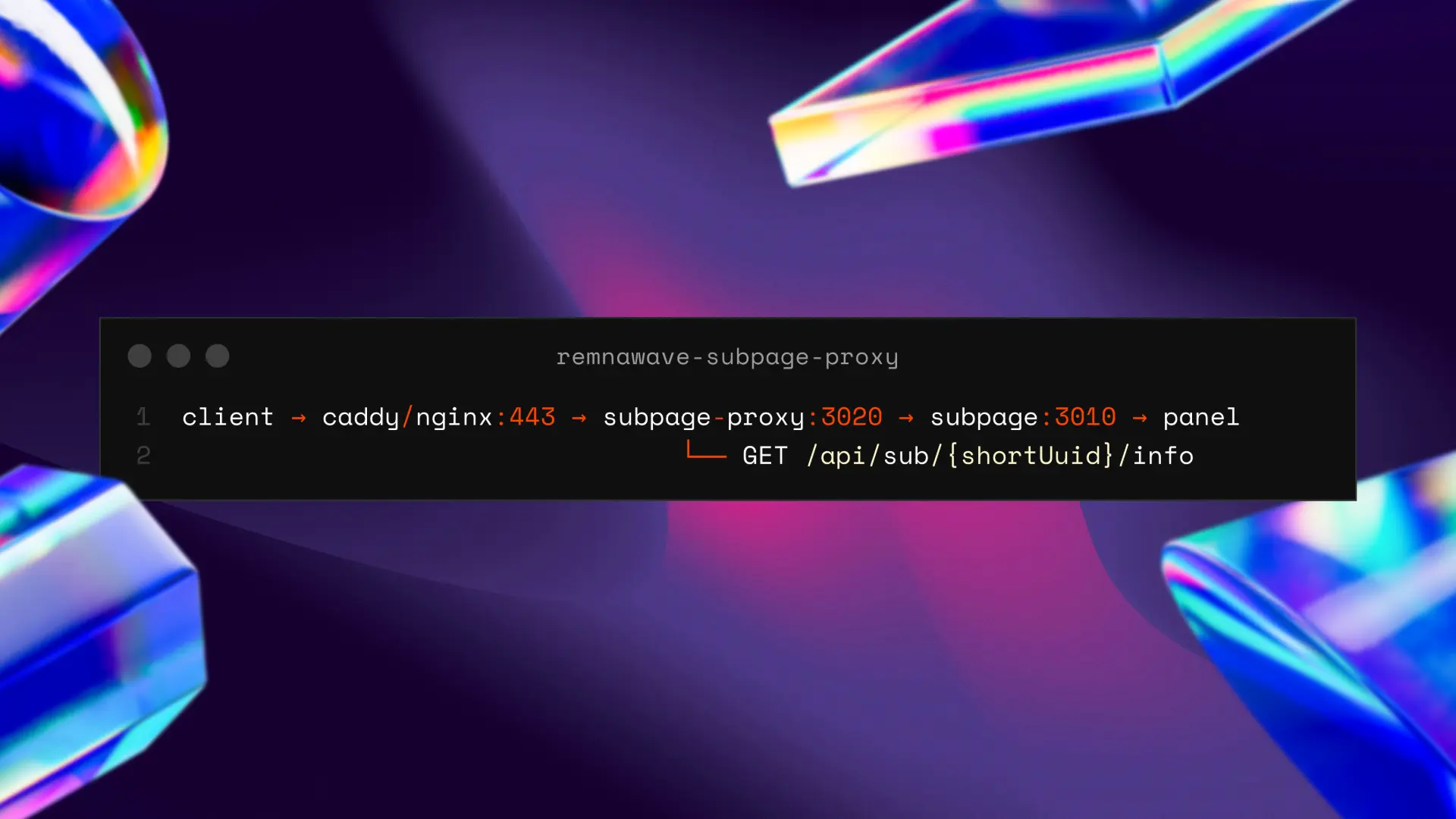
client → caddy/nginx :443 → subpage-proxy :3020 → subscription-page :3010 → panel
                                  │
                                  └── GET /api/sub/{shortUuid}/info   (only when needed)
Traffic and expiry placeholders come from the subscription-userinfo header on
every subscription response, so the common case requires no API request. The
panel is queried only for data the headers cannot supply, such as {USERNAME}
or {USER_STATUS}; those lookups are cached and de-duplicated.
Quick start
git clone https://github.com/hteppl/remnawave-subpage-proxy.git
cd remnawave-subpage-proxy

cp .env.example .env
cp .env.subscription-page.example .env.subscription-page
cp config.example.yaml config.yaml

# Fill in REMNAWAVE_API_TOKEN in both .env files.
# Create the token in Remnawave Dashboard → Remnawave Settings → API Tokens.

docker compose pull
docker compose up -d
config.yaml is optional: without it, the proxy resolves the placeholders
defined in the panel's Custom Response Headers.
To build from source instead of the published image, run make dev: it applies
docker-compose.dev.yml, which builds the :dev tag locally, sets logging to
debug/text and publishes the health port on 3021.
Finally, point the reverse proxy at the proxy rather than the subscription page.
No port is published on the host — the containers live only on
remnawave-network — so a reverse proxy on that network addresses them by name.
sub.example.com {
    reverse_proxy remnawave-subpage-proxy:3020
}
If the reverse proxy runs on the host instead, publish the port by adding
ports: ['127.0.0.1:3020:3020'] to the service in the compose file.
Existing subscription page deployment
Use docker-compose.proxy-only.yml and drop the ports: mapping from the
subscription page's compose file, so it is reachable only through the proxy.
cp .env.example .env
cp config.example.yaml config.yaml
docker compose -f docker-compose.proxy-only.yml up -d
Production notes
A specific version should be pinned rather than tracking latest. Both compose
files run the container read-only, with all capabilities dropped,
no-new-privileges set, and the JSON log file capped at 3 × 10 MB.
LOG_FORMAT=json is recommended where logs are forwarded to an external system.
HTTP_SHUTDOWN_TIMEOUT must stay below the compose stop_grace_period (15s and
20s by default), so in-flight requests finish before the container is stopped.
The panel is verified once at startup; a failure is logged at error level but does not prevent operation.
Configuring the announce
The template may be defined in either place, and both are applied.
From the panel — Remnawave Settings → Subscription Settings → Custom Response Headers:
| Header | Value |
|---|---|
announce | Used {TRAFFIC_USED} of {TRAFFIC_LIMIT} |
The proxy resolves the placeholders in the outgoing response; nothing else is
required. The panel's {{VAR}} templates can sit in the same value, so
{{USERNAME}}: {TRAFFIC_USED} of {TRAFFIC_LIMIT} works. A value stored with the
panel's rwEncodeBase64: prefix arrives as base64:… and is handled the same
way. scan_all_headers is on by default, so this applies to any header the
panel sets, and base64 values are decoded, resolved and re-encoded in place.
From config.yaml — for templates kept in version control, or needing
conditions:
vars:
  BRAND: "MyProject"
  SUPPORT: "@my_support_bot"

headers:
  - name: announce
    template: "{BRAND} · {TRAFFIC_USED} of {TRAFFIC_LIMIT} used · {DAYS_LEFT} days left · {SUPPORT}"
    encode: base64-prefixed   # required by Happ
    max_length: 200           # Happ displays at most 200 characters

  # Alternative message once the plan is exhausted.
  - name: profile-title
    template: "{BRAND} — {TRAFFIC_AVAILABLE}"
    encode: base64
    max_length: 25
Every option is documented in config.example.yaml, and
examples/ holds ready-made configurations for common setups.
Placeholders
Syntax is {NAME}, with optional chained modifiers: {NAME|upper},
{NAME|lower}, {NAME|trim}, {NAME|truncate:40}, {NAME|default:n/a}. Names
use UPPER_SNAKE_CASE, so JSON and Clash payloads passing through the proxy are
never interpreted as templates.
Resolved without a panel request
The Remnawave column names the panel's own variable, where one exists.
| Placeholder | Example | Remnawave |
|---|---|---|
{TRAFFIC_USED} | 10.50 GB | {{TRAFFIC_USED}} |
{TRAFFIC_LIMIT} | 100.00 GB | {{TOTAL_TRAFFIC}} |
{TRAFFIC_AVAILABLE} | 89.50 GB (limit minus used) | {{TRAFFIC_LEFT}} |
{TRAFFIC_USED_BYTES} | 10500000000 | {{TRAFFIC_USED_BYTES}} |
{TRAFFIC_LIMIT_BYTES} | 100000000000 | {{TOTAL_TRAFFIC_BYTES}} |
{TRAFFIC_USED_IN_LIMIT} | 3.0 (used, in the limit's unit, no suffix) | — |
{TRAFFIC_LIMIT_VALUE} | 20.0 (limit, no suffix) | — |
{TRAFFIC_UNIT} | GB (the unit both share) | — |
{TRAFFIC_AVAILABLE_BYTES} | 89500000000 | {{TRAFFIC_LEFT_BYTES}} |
{TRAFFIC_UPLOAD} | 0.50 GB | — |
{TRAFFIC_DOWNLOAD} | 10.00 GB | — |
{TRAFFIC_USED_PERCENT} | 10 | — |
{TRAFFIC_LEFT_PERCENT} | 90 | — |
{PROGRESS_BAR} | ▰▱▱▱▱▱▱▱▱▱ | — |
{DAYS_LEFT} | 12 | {{DAYS_LEFT}} |
{EXPIRES_AT} | 31.12.2026 23:59 | — |
{EXPIRES_AT_DATE} | 31.12.2026 | — |
{EXPIRES_AT_TIME} | 23:59 | — |
{EXPIRES_AT_UNIX} | 1798761599 | {{EXPIRE_UNIX}} |
{SHORT_UUID} | aBcDeF123 | {{SHORT_UUID}} |
{CLIENT_TYPE} | clash | — |
{USER_AGENT} | Happ/1.0 | — |
{CLIENT_IP} | 203.0.113.9 | — |
{ORIGINAL_VALUE} | the header's own text, before rewriting | — |
{NOW} {DATE} {TIME} | 01.09.2026 14:30 | — |
{SUBSCRIPTION_URL} | https://example.com/sub/aBcDeF123 | {{SUBSCRIPTION_URL}} |
Where the panel has an equivalent, the native variable is usually the simpler
choice. The proxy's version differs where noted: an unlimited plan renders as
∞ rather than 0, and values follow the proxy's own formatting.
{TRAFFIC_USED_IN_LIMIT}, {TRAFFIC_LIMIT_VALUE} and {TRAFFIC_UNIT} render
both sides of a quota in one shared unit: {TRAFFIC_USED_IN_LIMIT} of {TRAFFIC_LIMIT} gives 0.0 of 20.0 GB where {TRAFFIC_USED} would give
0 B of 20.0 GB. The unit follows the limit.
{ORIGINAL_VALUE} holds the text the panel sent for the header the rule targets,
decoded if it was base64, so a template can wrap the panel's announce rather
than discard it; placeholders the panel used are resolved inside it.
{SUBSCRIPTION_URL} is rebuilt from the incoming request, so it needs no panel
request; the client-type segment is dropped, and /{shortUuid}/clash yields the
plain /{shortUuid} link.
An unlimited plan renders {TRAFFIC_LIMIT} and {TRAFFIC_AVAILABLE} as ∞
(configurable), as does {EXPIRES_AT} without an expiry date.
Requiring a panel request (cached)
| Placeholder | Example | Remnawave |
|---|---|---|
{USERNAME} | alice | {{USERNAME}} |
{USER_STATUS} | ACTIVE DISABLED LIMITED EXPIRED | {{STATUS}} |
{IS_ACTIVE} | true | {{STATUS:ACTIVE=true|…}} |
{TRAFFIC_LIMIT_STRATEGY} | NO_RESET DAY WEEK MONTH MONTH_ROLLING | {{RESET_STRATEGY}} |
{LIFETIME_TRAFFIC_USED} | 1.20 TB | {{LIFETIME_USED_BYTES}} (bytes) |
In addition, any variable defined under vars: in config.yaml.
Every placeholder in this table has a native counterpart that costs no API
request, since the panel fills it while building the response. In a header the
panel sets, prefer {{USERNAME}} to {USERNAME}. The proxy's versions exist
for config.yaml rules and for conditions such as user_statuses.
Conditions
Rules may be scoped so different clients or users receive different text:
headers:
  # Happ only.
  - name: announce
    template: "{PROGRESS_BAR} {TRAFFIC_USED_PERCENT}% used"
    encode: base64-prefixed
    when:
      user_agent: "(?i)happ"

  # Client-type paths /json and /clash only; `user_statuses` works the same way.
  - name: X-Plan-Summary
    template: "{TRAFFIC_USED} / {TRAFFIC_LIMIT}"
    when:
      client_types: [ json, clash ]

  # Plans with a finite quota; `false` matches unlimited plans.
  - name: announce
    template: "{TRAFFIC_USED} of {TRAFFIC_LIMIT} used"
    encode: base64-prefixed
    when:
      has_traffic_limit: true

  # Default value, applied only if the panel did not send the header.
  - name: support-url
    template: "https://t.me/my_support_bot"
    when:
      exists: false
has_traffic_limit distinguishes a finite quota from an unlimited plan, which
Remnawave encodes as a zero total. It comes from the subscription-userinfo
header, so it normally costs no panel request, and a rule is skipped when the
quota cannot be determined at all.
traffic.force_unlimited does not affect it: that option changes what the client
is shown, while has_traffic_limit tests the quota configured in the panel, so a
plan presented as unlimited still matches has_traffic_limit: true.
user_statuses always triggers a panel request, as the status is absent from
the response headers.
Remnawave's Response Rules can also match a user agent, but the headers they add are sent verbatim, without templates, and they cannot test the user's status or quota. Selecting a config template or excluding hosts per client is done better in Response Rules; the text of the header is done here.
Configuration reference
Infrastructure is configured through environment variables, templating through
config.yaml. Defaults below apply when a variable is unset;
.env.example overrides several.
| Variable | Default | Meaning |
|---|---|---|
UPSTREAM_URL | — | Subscription page to proxy. Required. |
REMNAWAVE_PANEL_URL | — | Panel base URL, unless PANEL_ENABLED=false. |
REMNAWAVE_API_TOKEN | — | Panel API token, unless PANEL_ENABLED=false. |
APP_HOST | 0.0.0.0 | Public bind address. |
APP_PORT | 3020 | Public port. |
HEALTH_HOST | 0.0.0.0 | Bind address for the health endpoints. |
HEALTH_PORT | 3021 | Health port. 0 disables both endpoints. |
CONFIG_PATH | config.yaml | Header rules file. Missing is an error only when set explicitly. |
CUSTOM_SUB_PREFIX | — | Path prefix. Must match the subscription page's setting. |
TRUST_PROXY | 1 | true/false, a hop count, or presets, IPs and CIDRs. |
UPSTREAM_FORCE_HTTPS | false | Always send X-Forwarded-Proto: https upstream. |
PANEL_ENABLED | true | false runs without panel credentials. |
PANEL_ALWAYS_FETCH | false | Look up every subscription, even when nothing needs it. |
PANEL_FORWARD_REAL_IP | true | Send the end user's IP on info lookups. |
PANEL_TIMEOUT | 10s | Timeout for one panel API call. |
CACHE_TTL | 30s | How long a successful panel lookup is reused. |
CACHE_NEGATIVE_TTL | 10s | How long a "not found" is remembered. |
CACHE_MAX_ENTRIES | 10000 | Cap on cached lookups. |
CADDY_AUTH_API_TOKEN | — | X-Api-Key for a panel behind Caddy security. |
CLOUDFLARE_ZERO_TRUST_CLIENT_ID | — | CF-Access-Client-Id for Cloudflare Zero Trust. |
CLOUDFLARE_ZERO_TRUST_CLIENT_SECRET | — | CF-Access-Client-Secret for the same. |
SUBSCRIPTION_CACHE_ENABLED | false | Replay the last good response while Remnawave is down. |
SUBSCRIPTION_CACHE_TTL | 1h | How long a stored response stays usable. |
SUBSCRIPTION_CACHE_MAX_BYTES | 64MiB | Total memory budget for the fallback cache. |
SUBSCRIPTION_CACHE_MAX_BODY | 1MiB | Largest single response worth storing. |
UPSTREAM_TIMEOUT | 60s | Wait for upstream response headers. |
HTTP_READ_TIMEOUT | 30s | Reading the client request. |
HTTP_WRITE_TIMEOUT | 90s | Writing the response. |
HTTP_IDLE_TIMEOUT | 120s | Keep-alive idle time. |
HTTP_SHUTDOWN_TIMEOUT | 15s | Drain on SIGTERM. Keep below stop_grace_period. |
LOG_LEVEL | info | debug logs every header rewrite. |
LOG_FORMAT | text | text or json. |
A duration without a unit means seconds, so CACHE_TTL=45 and CACHE_TTL=45s
are equivalent. A byte size accepts 1MiB, 512KB or a plain number.
Forcing an unlimited plan
traffic.force_unlimited hides the quota from the client's built-in traffic
display, whatever the panel has configured:
traffic:
  force_unlimited: true
The subscription-userinfo header is sent with total=0, the standard encoding
for an unlimited plan and the value client apps read for their quota display.
Only that header is rewritten: placeholders and conditions keep reporting the
real quota, so {TRAFFIC_LIMIT} still yields 100.00 GB and
has_traffic_limit: true still matches. It controls the one thing a template
cannot — the app's own traffic readout.
Subscription fallback cache
Disabled by default; enabled with SUBSCRIPTION_CACHE_ENABLED=true. The proxy
then keeps the last successful subscription response per client and replays it
while Remnawave is unreachable, so existing users keep a working configuration
through a panel outage or a page restart.
This is a fallback, not a read-through cache: every request goes to the upstream
first, and the stored copy is used only if that fails — a dropped connection, a
timeout, or a 5xx response. Entries are keyed by short UUID, client type,
User-Agent and Accept-Encoding, since Remnawave varies the payload by
client; only subscription payloads are stored, never the web page.
Two consequences: traffic counters in a replay are as old as the cache entry,
and a user revoked during an outage keeps access until SUBSCRIPTION_CACHE_TTL
expires.
Shuffling hosts
Clients tend to connect to the first host in a subscription, so a fixed order
sends every user to the same server. hosts.shuffle groups hosts by a Go regexp
matched against the name the client shows — the link fragment or vmess ps,
Xray remarks, the sing-box tag, the Clash proxy name. On each request a
group's hosts are shuffled among the positions they already hold, while a host
matching no pattern keeps its place:
hosts:
  shuffle:
The full README is on GitHub.
Tag summary
Content type
Image
Digest
sha256:88cc3cdfc…
Size
7.4 MB
Last updated
1 day ago
docker pull hteppl/remnawave-subpage-proxy