infinilabs/console
INFINI Console, the easiest way to operate your own elasticsearch/opensearch platform.
100K+
infinilabs/console repository overview
INFINI Console
Introduction
INFINI Console is a very lightweight multi-cluster, cross-version unified Elasticsearch/OpenSearch governance platform. Through the centralized management of Elasticsearch/OpenSearch, you can quickly and conveniently manage multiple sets of Elasticsearch/OpenSearch clusters within the enterprise.
INFINI Console – The Choice of Elasticsearch Professionals. Be an Elasticsearch Pro Today!
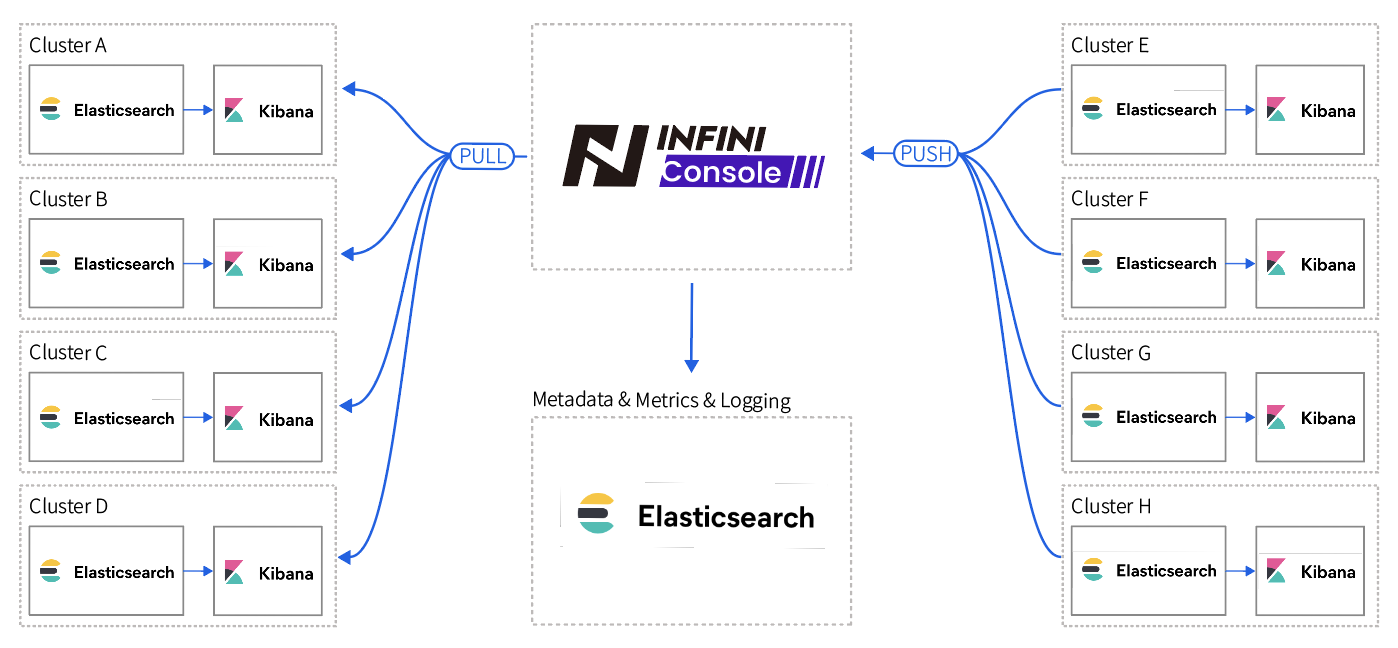
INFINI Console is written in Golang, the installation package is very small, only about 18MB, there is no external environment dependency, deployment and installation are very simple, just need to download the binary executable file of the corresponding platform, start the application and then you are good to go.
Features
- Support multi-cluster management, you can manage any number of clusters at the same time in one platform;
- Multi-version Elasticsearch support, support 1.x, 2.x, 5.x, 6.x, 7.x, 8.x;
- Supports grouping and managing cluster metadata information on a project-by-project basis, support custom tags;
- Support dynamic clusters registration, and the target cluster can be accessed and managed on the fly;
- Supports viewing the historical version of cluster metadata, and can view the changes and audits of cluster metadata.
- Developer tools support multiple workspaces to quickly switch, support smart suggestion, support frequent used commands to save and load;
- Support unified monitoring of any version, including cluster, node, index and other very detailed dimensions of the indicator viewing and analysis;
- Support common management operations of indices, support quick viewing and browsing of indices, and support updates and deletes of documents in the index;
- Support the creation of indexed data views, you can modify the display format of fields, and support the quick viewing of time series index data;
- Support for cross-platform deployment environments, support for MacOS (Intel and M1), Windows (32-bit and 64-bit), Linux (32-bit and 64-bit);
- Support x86, arm5, arm6, arm7, mips, mipsle, mips64 and other CPU architectures:
- Support for Docker containers and K8s cloud-native environments;
- Support for the management of INFINI gateways;
Screenshot


Getting Started
# IMPORTANT: Use a specific tag (e.g., 1.2.3) instead of 'tag'.  See Docker Hub for available tags.
docker run -p 9000:9000   infinilabs/console:tag
Who is using?
If you are using INFINI Console and happy to tell others that you are using, please leave message to our Github issue, we'd happy to list you here.

Tag summary
Content type
Image
Digest
sha256:e9282cf32…
Size
25.9 MB
Last updated
3 months ago
docker pull infinilabs/console:1.31.0_NIGHTLY-20260812