jaredreisinger/sensorpush-proxy
A rate-limiting, authentication-hiding proxy for SensorPush data.
1.0K
jaredreisinger/sensorpush-proxy repository overview
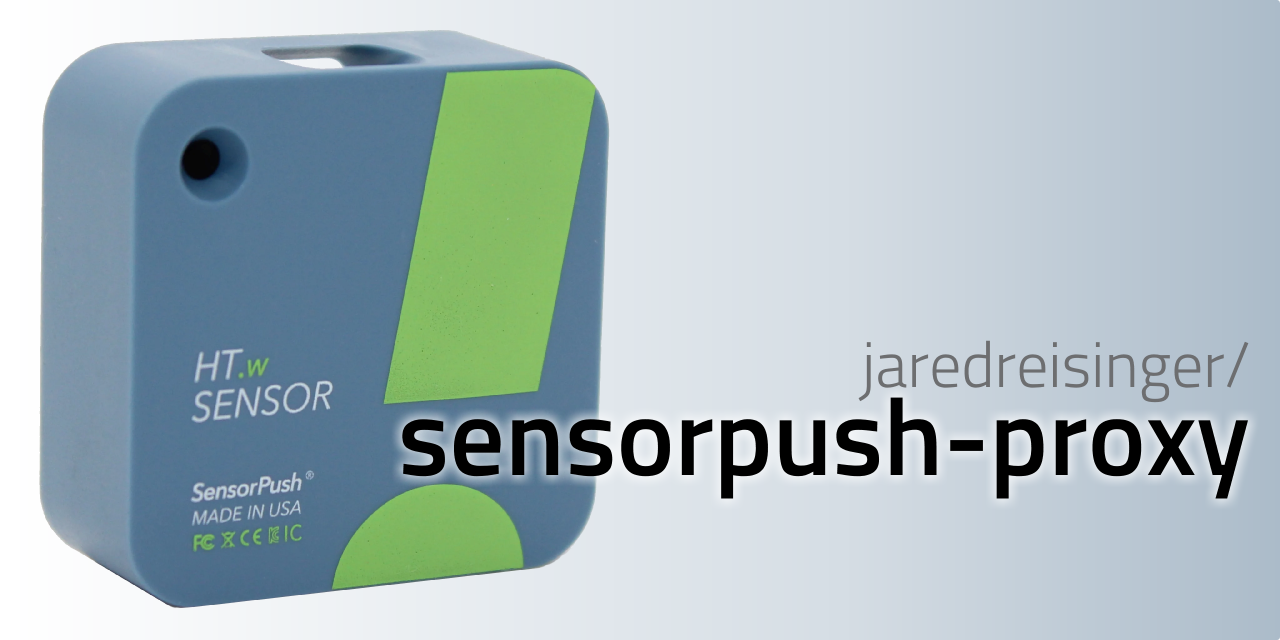
A rate-limiting, authentication-hiding proxy for SensorPush data.





Usage
For non-Docker usage, see the main README.
Get SensorPush credentials
If you have any SensorPush devices, you ought to already have an account with SensorPush. In order to activate API access, you need to sign into their Gateway Cloud Dashboard at least once and agree to the terms of service. Once you've done that, the username and password you use for that dashboard are the same ones you need for this proxy. Unfortunately, SensorPush does not allow you to create limited-use (and revocable) tokens to use in place of your password for API access. This proxy uses the password you provide only to retrieve the sensor data you request. Use security best practices to ensure that the password configuration you pass to this proxy is kept secret/encrypted until the last possible moment.
Get sensorpush-proxy
Use docker pull jaredreisinger/sensorpush-proxy to retrieve the Docker image.
NOTE: Version 0.1.0 of the Docker image (the current latest version) does not include any SSL certificates, which means that you will more than likely see certificate failures when you attempt to use thequeryorproxysub-commands. For now, bind-mount the host's/etc/ssl/certsdirectory into the container, or build a new image that includes these files. I'm working on a fix that will ensure the standard CA root certs are included in the default image.UPDATE: This is fixed as of v0.1.1, but note that you can still bind-mount
/etc/ssl/certsor build a new image if you encounter CA/certification issues.
Discover sensor IDs
Use the query subcommand with your SensorPush credentials to discover the sensor IDs available to you. (Shown here across multiple lines for readability...)
docker run --rm -ti \
  jaredreisinger/sensorpush-proxy \
  query --username YOUR_SENSORPUSH_USERNAME --password YOUR_SENSORPUSH_PASSWORD
You should see as output several log lines that show the name, ID, and type of the sensors on your account (IDs shown below are not real!):
2023/01/17 15:30:24 Kitchen
2023/01/17 15:30:24   ID  : "123456.67834768348756683478"
2023/01/17 15:30:24   Type: HT1
2023/01/17 15:30:24 Humidor
2023/01/17 15:30:24   ID  : "134567.9834598734598734598"
2023/01/17 15:30:24   Type: HT1
2023/01/17 15:30:24 Garage
2023/01/17 15:30:24   ID  : "135678.0934908340980985858"
2023/01/17 15:30:24   Type: HT1
Figure out your desired configuration and run the proxy
sensorpush-proxy supports configuration by command-line flags, by environment variables, or by configuration file; use whichever form or combination of forms is the most convenient. However, please be aware of the risk of putting your SensorPush password in plaintext in any form. The generally-accepted best practice for things like passwords is to keep them as secrets in your CI/CD pipeline or container orchestration tool, and to provide them to sensorpush-proxy from there. That said, the examples here won’t show any use of secrets.
Given the above example, let’s assume that we want to proxy the “Kitchen” (123456.67834768348756683478) and “Garage” (135678.0934908340980985858) sensors, using the names “inside” and “outside” respectively.
As command-line flags
(Shown here across multiple lines for readability...)
docker run --rm -ti \
  -p 5375:5375 \
  jaredreisinger/sensorpush-proxy \
  proxy \
    --username YOUR_SENSORPUSH_USERNAME \
    --password YOUR_SENSORPUSH_PASSWORD \
    --sensors inside=123456.67834768348756683478,outside=135678.0934908340980985858
As environment variables
docker run --rm -ti \
  -p 5375:5375 \
  -e SPP_SENSORPUSH_USERNAME=YOUR_SENSORPUSH_USERNAME \
  -e SPP_SENSORPUSH_PASSWORD=YOUR_SENSORPUSH_PASSWORD \
  -e SPP_PROXY_SENSORS=inside=123456.67834768348756683478,outside=135678.0934908340980985858 \
  jaredreisinger/sensorpush-proxy \
  proxy
As a config file
(in ./config.yaml, say)
sensorPush:
  username: YOUR_SENSORPUSH_USERNAME
  password: YOUR_SENSORPUSH_PASSWORD

proxy:
  sensors:
    inside: "123456.67834768348756683478"
    outside: "135678.0934908340980985858"
docker run --rm -ti \
  -v ${PWD}:/tmp
  -p 5375:5375 \
  jaredreisinger/sensorpush-proxy \
  proxy \
    --config /tmp/config.yaml
Call the API
There is only one API endpoint exposed at present, /sensors, which returns a JSON object keyed by the sensor names from the configuration. This example pipes through jq purely for prettier formatting:
curl http://localhost:5375/sensors | jq .
{
  "inside": {
    "altitude": 0,
    "barometric_pressure": 0,
    "dewpoint": 0,
    "humidity": 60.8,
    "observed": "2023-01-25T21:02:55Z",
    "temperature": 64.4,
    "vpd": 0
  },
  "outside": {
    "altitude": 0,
    "barometric_pressure": 0,
    "dewpoint": 0,
    "humidity": 56.2,
    "observed": "2023-01-25T21:03:35Z",
    "temperature": 50.1,
    "vpd": 0
  }
}
Background
For further details, peruse the background and/or other documentation in the docs folder.
Tag summary
Content type
Image
Digest
sha256:ef54ab9ce…
Size
4 MB
Last updated
over 1 year ago
docker pull jaredreisinger/sensorpush-proxy