lsbnb/netmedex repository overview
NetMedEx v1.5.3: AI-Powered Biomedical Knowledge Discovery 🧬✨
NetMedEx is an AI-driven platform that transforms biomedical abstracts from PubTator3 into interactive, actionable knowledge graphs. It bridges the gap between structured networks and unstructured text using a Hybrid Retrieval-Augmented Generation (Hybrid RAG) engine powered by graph traversal and semantic vector search.
🌟 Why NetMedEx?
While other tools simply list entities, NetMedEx interprets the links. It provides the scaffolding for discovery, allowing researchers to navigate the complex landscape of genes, diseases, chemicals, and species with AI as their co-pilot.
🚀 Core Capabilities
- 🧠 Smart 2-Hop Graph RAG: Discovers latent mechanistic chains (A → B → C) scored by Hybrid Scoring 2.0 — combining topological NPMI, semantic confidence, and query relevance.
- 🕸️ Interactive Visualization: Explore co-mention and semantic networks with real-time layout adjustments, community detection, and sub-network selection.
- ⚡ Semantic Extraction: Automatically identifies relationship types (e.g., inhibits, treats, activates) with calibrated confidence scores and direct evidence sentences.
- 🌐 Universal Translation: Search and chat in English, Traditional Chinese, Japanese, or Korean. AI handles the translation to optimized PubTator syntax.
- 🐭 Species Differentiation: Clearly distinguishes human clinical findings from animal/cell-line model results in every AI response.
- 💾 Full Session Portability: Export your entire research state as a Graph File (.pkl) and restore it instantly — no re-analysis required.
🆕 What's New in v1.5.3
- Better Layer 3 Evidence Recovery: High-confidence directional edges were being discarded purely because the query happened to anchor on the "wrong" end of the edge. Single-hop edges are now correctly kept and stated in their true direction.
- Provider-Switch Model Bug Fixed: Switching LLM providers without explicitly specifying a model no longer risks sending the previous provider's model name to the new one.
- Realistic Local-Model Time Estimates: The semantic-analysis progress message now gives a much wider, honest time estimate for large local models.
Previous: v1.5.2
- Cross-Literature Conflict Detection: When two PMIDs report opposite regulatory direction for the same edge (e.g. one says "inhibits", another "activates"), Chat's Layer 3 now surfaces both sides as an explicit, unresolved Literature Conflict instead of silently picking one.
- Sharper Layer 3 Causal-Mechanism Reasoning: Raised the local-model (Ollama) chat token budget so Layer 3's evidence table, Weakest Link, Testable Prediction, and Suggested Validation fields are no longer truncated mid-response.
- In-Chat Rebuild Nudge: When a turn has no directional edges to reason over and the network wasn't already built with Semantic Analysis, Chat now suggests rebuilding with that edge method directly in its reply.
- Faster Failure When No LLM Is Configured: Selecting Semantic Analysis without a configured LLM key now fails immediately instead of after the full literature search completes.
- Semantic Analysis Is Now the Default Edge Method: New networks are built with
Semantic Analysis (LLM)by default instead ofCo-occurrence, so Layer 3's causal-mechanism reasoning has directional evidence to work with out of the box.Co-occurrenceis still available (and the right pick before an API key is configured) — its symmetric-only edges leave Layer 3 with nothing to reason over.
Previous: v1.5.1
- Type-Constrained Biomedical Acronym & MeSH Standardisation: Integrated
BIOMEDICAL_ACRONYM_MAPand MeSH CUI lookup intonormalize_knowledge_graphto expand common medical acronyms (e.g.,RAin Disease ➔rheumatoid arthritis,RAin Chemical ➔retinoic acid) while protecting Gene, Mutation, and SNP nodes. - Cytoscape Canvas Height Stability: Implemented
cy_container_visibilityto enforce container height (800px), preventing inline style overrides from collapsing the Cytoscape graph canvas to0pxduring layout transitions. - Diskcache WAL Checkpoint Safeguard: Added SQLite WAL checkpoint (
PRAGMA wal_checkpoint(PASSIVE)) prior to graph restoration callbacks, preventing SQLite WAL accumulation from blocking progress updates. - LLM Error Log Sanitisation & UI Animations: Applied error message sanitisation before logging LLM exceptions to prevent API key exposure in log outputs, and enhanced progress bars with staged pacing delays.
Previous: v1.5.0
- FastAPI Bridge Memory Reclamation & TTL: Added automated LRU session eviction and time-based expiration (default 2 hours) to
_SessionStore, preventing memory accumulation during programmatic API and batch search runs. - GraphBuilder Lifecycle State Protection: Locked graph builder mutation states (
_is_built) to prevent destructive re-pruning on duplicatebuild()calls and guard against weight corruption from post-build additions. - Dependency & Environment Hardening: Added explicit dependency verification for optional semantic extractors, graceful context-length exceeded error translation in Chat, and $10^{-9}$ floating-point tolerance in NPMI calculations.
Previous: v1.4.0
- Relation-Direction Verification (optional 2nd LLM): New opt-in toggle in Advanced Settings runs a second verification pass over directional semantic edges (e.g. inhibits, upregulates), checking each against its supporting evidence quote and downgrading unconfirmed directions to a neutral associated_with instead of dropping them. Choose a verifier provider independent from your main LLM for the best odds of catching an extraction error.
- Numeric-Artifact Node Filter: Defensively rejects graph nodes whose display name is purely numeric (an occasional PubTator3 upstream annotation artifact).
Previous: v1.3.6
- Deterministic ChromaDB Retrieval: Stabilized vector retrieval result ordering for reproducible RAG outputs when candidate scores tie.
Previous: v1.3.5
- Deterministic 2-Hop Traversal: Stabilized 2-hop path traversal ordering for reproducible graph reasoning results.
Previous: v1.3.4
- Version Alignment: Corrected remaining version strings across
README.md,DEPLOYMENT.md,DOCKERHUB_OVERVIEW.md, and the web application sidebar UI to align with releasev1.3.4.
Previous: v1.3.3
- LLM Provider UI & Local Models: Support for local model configuration and provider UI improvements with session isolation.
- Offline Cache Support: Pre-downloads tiktoken BPE cache in the builder stage to support air-gapped container environments.
- Defensive Safeguards: Normalization toggle is automatically disabled when no LLM is configured.
- Config & Data Cleanups: Redacted internal development variables, expanded
.env.exampleto templates for all 7 providers, and excluded Pediatric CNS data from GitHub and Docker builds.
Previous: v1.3.2
-
Search Nodes @Type Syntax: Type
@Gene,@Disease,@Gene:gut, orkeyword, @Genein the Search Nodes field to highlight, filter, or path-search by biological entity type. Top-20 anchor selection uses PMID literature count as the importance criterion. -
Chat Download History Fix: Download now exports the full unbounded message log, matching what the user sees in the UI chat panel.
-
Search Nodes Tooltip: Improved info tooltip with @Type usage examples, anchor/path-node color legend, and silent-skip behaviour note.
-
WAL Hang Fix: Resolves Chat panel permanently stuck at "Preparing abstracts..." — diskcache SQLite WAL is now checkpointed before each analysis run, preventing write-blocking from accumulated background callback writes.
-
Adaptive Chat Response Modes: The 5-layer system prompt now selects response format based on question type: Compact Mode for simple factual queries, Layer 2 skip conditions to avoid empty structured blocks, and adaptive Layer 5 question count (3 for broad analyses, 1 for focused follow-ups, none for Compact Mode).
Previous: v1.3.0
- Anthropic API Integration: Full native support for Anthropic Claude models (e.g.,
claude-3-5-sonnet,claude-3-opus) as a core LLM provider in both the web application (Advanced Settings UI) and CLI/API interfaces. - Advanced LLM Settings & Customization: Rewrote LLM initialization and configuration parsing (
llm.pyandadvanced_settings.py) to support multi-provider environments, dynamic testing of connection status for Anthropic/OpenAI/Gemini/Groq/NVIDIA NIM, and direct environment configuration saving to.env. - CJK / Universal Translation Robustness: Strict universal language requirements inside prompts for non-English users, enforcing CJK output generation for all headers, labels, and structured segments.
- Token Usage & Cost Analysis: Added complete documentation for cost calculation per pipeline stage (
docs/token_cost.md), including strategies for cost minimization using lighter models or co-occurrence graphs. - Biomedical RAG Platform Comparisons: Published comparative analysis documentation against MRTKG (
docs/NetMedEx_vs_MRTKG_comparison.md) describing architectural advantages.
🛠️ Quick Start
Launch the interactive dashboard on localhost:8050:
Method A: Docker Desktop (GUI)
- Search for
lsbnb/netmedexin the top search bar of Docker Desktop and click Pull. - Go to the Images tab, locate
lsbnb/netmedex:latest, and click Run. - Expand Optional settings:
- Set Host port to
8050(maps host port 8050 to container port8050/tcp). - (Optional) Set Container name to
NetMedEx.
- Set Host port to
- Click Run, then open http://localhost:8050 in your browser.
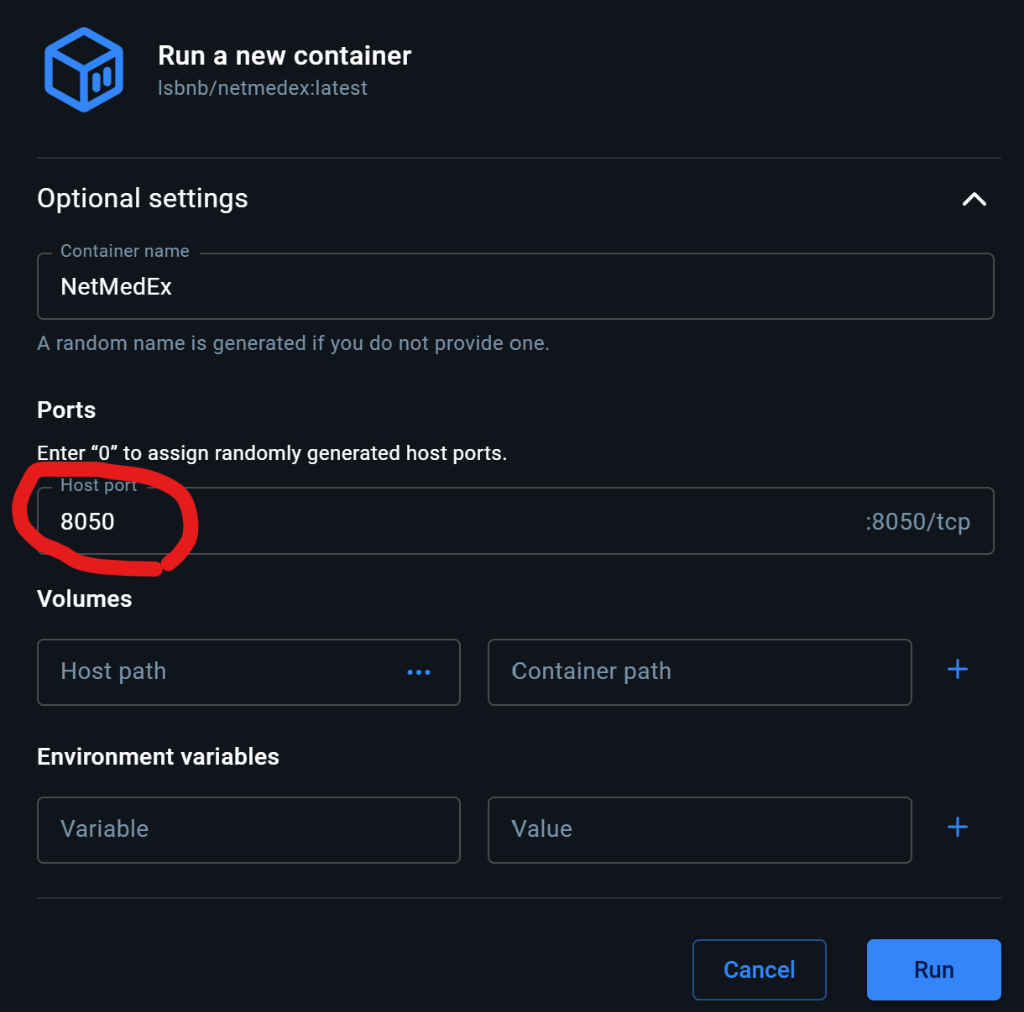
Configuring Host port (8050) in Docker Desktop Optional Settings.
Method B: Terminal Command Line
docker run -p 8050:8050 --rm lsbnb/netmedex
🔓 Unlock Full AI Power
Pass your LLM API key to enable Semantic Analysis and Hybrid RAG Chat:
# OpenAI
docker run -p 8050:8050 --rm \
  -e OPENAI_API_KEY='sk-...' \
  lsbnb/netmedex

# Google Gemini
docker run -p 8050:8050 --rm \
  -e LLM_PROVIDER=google \
  -e GEMINI_API_KEY='AIza...' \
  lsbnb/netmedex

# Local LLM (Ollama)
docker run -p 8050:8050 --rm \
  -e LLM_PROVIDER=local \
  -e LOCAL_LLM_BASE_URL='http://host.docker.internal:11434/v1' \
  -e LOCAL_LLM_MODEL='llama3' \
  lsbnb/netmedex

# NVIDIA NIM (Cloud)
docker run -p 8050:8050 --rm \
  -e LLM_PROVIDER=nvidia \
  -e NVIDIA_API_KEY='nvapi-...' \
  -e NVIDIA_NIM_MODEL='meta/llama-3.1-70b-instruct' \
  lsbnb/netmedex
📂 Persist Session Data
Mount a local directory to keep your graph sessions across container restarts:
docker run -p 8050:8050 --rm \
  -e OPENAI_API_KEY='sk-...' \
  -v $(pwd)/netmedex-data:/app/data \
  lsbnb/netmedex
🔗 Connect With Us
- GitHub: lsbnb/NetMedEx
- Documentation: Official Docs
- PyPI: netmedex
© 2026 Lab of Systems Biology and Network Biology (LSBNB) @ Institute of Information Science, Academia Sinica, TAIWAN.
Tag summary
Content type
Image
Digest
sha256:293abfe33…
Size
640.2 MB
Last updated
21 days ago
docker pull lsbnb/netmedex