mailtrap/mailtrap-local
Open-source local email sandbox: SMTP + web UI + API in one binary. Catch every email you send.
6.2K
mailtrap/mailtrap-local repository overview
Mailtrap Local — a local email sandbox for developers


GitHub · Docs · API · Mailtrap.io
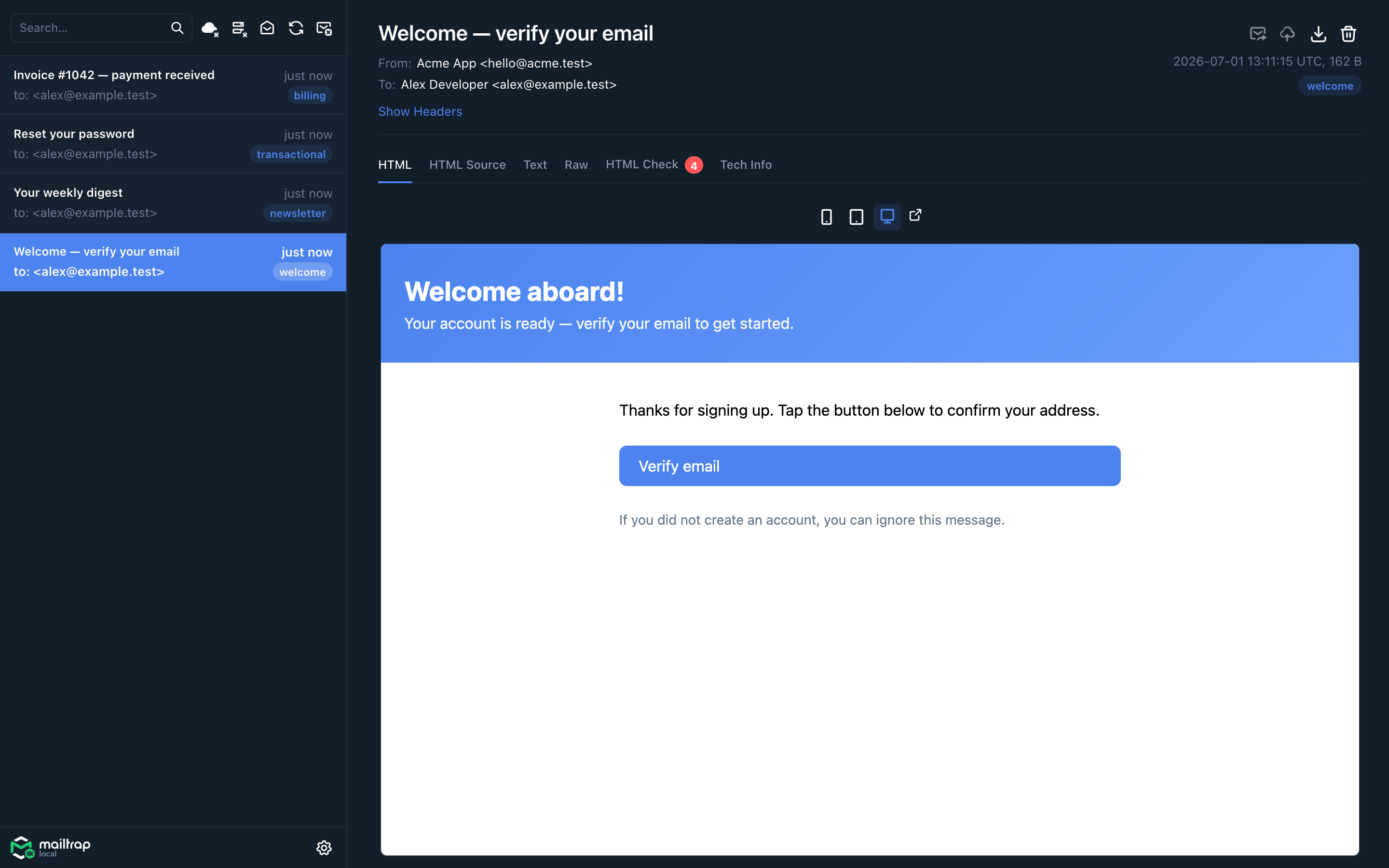
Mailtrap Local is an open-source SMTP server you run on your own machine. It catches every email your app sends, stores them in a local SQLite database, and gives you a web sandbox to browse, search, and inspect them in. Nothing leaves your machine unless you tell it to.
One self-contained binary in a distroless image — under 7 MB, linux/amd64 + linux/arm64, MIT-licensed.
Features
-
SMTP server on
3535— point any app, framework, or test suite at it. Anonymous SMTP — no authentication, no TLS, nothing to configure but the host and port. -
Web sandbox on
3550— search caught mail and inspect rendered HTML, plain text, raw source, headers, and attachments. -
REST API on
3550— documented with an OpenAPI 3.1 spec, served at/api/v1/openapi.yaml. -
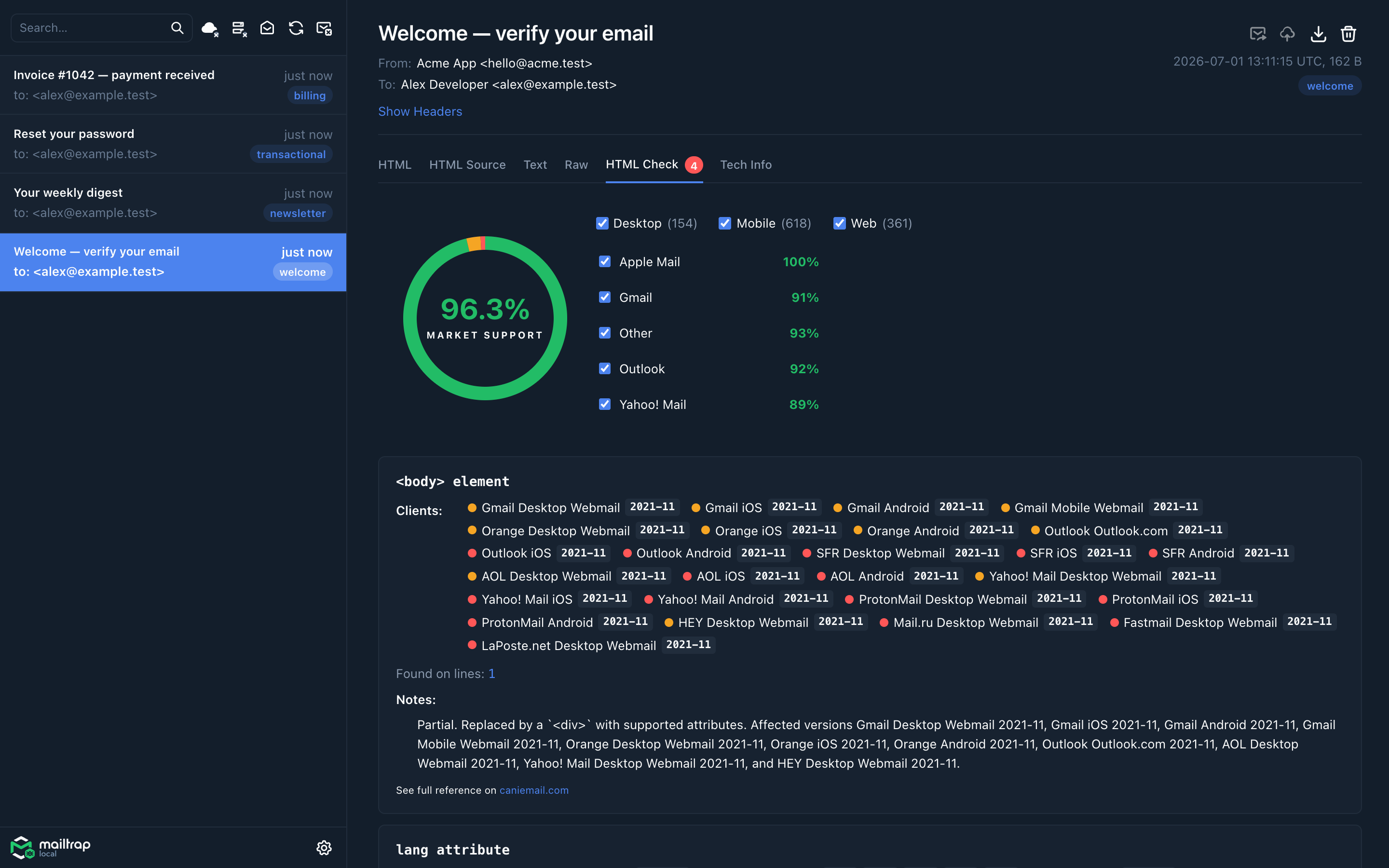
HTML check — score an email's compatibility across major mail clients, weighted by real client market share.
-
Send to Cloud — promote any caught message to your hosted Mailtrap sandbox in one click, so a designer or PM can review what your local code produced without shell access.
-
Relay and auto-relay — release a caught message through any upstream SMTP server (Mailtrap, SendGrid, Mailgun, SES, Postmark) when you need it to land in a real inbox.
-
Outbound webhooks — HMAC-signed
POSTon every caught message, so your app can react in tests. -
Categories — label mail at send time with
X-MT-Category(the same header convention as Mailtrap cloud) and filter on it in the UI and API. -
Live updates — new mail appears over a WebSocket, no refresh.
-
Automatic pruning — a configurable retention cap evicts the oldest messages.
Quick start
docker run -d \
  --name mailtrap-local \
  --restart unless-stopped \
  -p 3535:3535 \
  -p 3550:3550 \
  -v mailtrap-local:/var/lib/mailtrap-local \
  mailtrap/mailtrap-local:latest
Open http://127.0.0.1:3550 for the sandbox, and point your app's SMTP client at 127.0.0.1:3535.
| Port | Purpose |
|---|---|
3535 | SMTP ingest |
3550 | Web sandbox + REST API + WebSocket |
Docker Compose
services:
  mailtrap-local:
    image: mailtrap/mailtrap-local:latest
    restart: unless-stopped
    ports:
      - "3535:3535"
      - "3550:3550"
    volumes:
      - mailtrap-local:/var/lib/mailtrap-local

volumes:
  mailtrap-local:
Other services on the same Compose network reach the SMTP server at mailtrap-local:3535.
Persisting caught mail
The image declares a volume at /var/lib/mailtrap-local. It holds two files that belong together:
db.sqlite3— every caught messagesecret.key— encrypts the relay, cloud, and webhook credentials stored in that database
Mount the whole directory, not just the database. The image pins MAILTRAP_LOCAL_SECRET_KEY_FILE onto the volume for exactly this reason: if the key lived on the container filesystem, a docker pull upgrade would generate a fresh one and silently break every saved connection.
Runtime options
The image's default command already sets the flags a container needs:
| Flag | Value in the image |
|---|---|
--http-listen | 0.0.0.0:3550 |
--smtp-listen | 0.0.0.0:3535 |
--db | /var/lib/mailtrap-local/db.sqlite3 |
--unsafe-non-loopback | set |
If you override the command, keep --unsafe-non-loopback and repeat the other three — Docker replaces the default command wholesale rather than merging with it. The binary refuses to bind a non-loopback address without --unsafe-non-loopback, and inside a container it has to bind 0.0.0.0 to be reachable through -p. Host exposure is still governed by your port mapping, not by the bind.
Configuring cloud, relay, and webhooks
You can set these in the UI, or pin them from a YAML file mounted into the container:
docker run -d \
  -p 3535:3535 -p 3550:3550 \
  -v mailtrap-local:/var/lib/mailtrap-local \
  -v "$PWD/config.yml:/etc/mailtrap-local/config.yml:ro" \
  -e MAILTRAP_LOCAL_CONFIG=/etc/mailtrap-local/config.yml \
  -e MAILTRAP_API_TOKEN=... \
  mailtrap/mailtrap-local:latest
storage:
  max_messages: 500
cloud:
  api_token: ${MAILTRAP_API_TOKEN}
  sandbox_id: 1234567
relay:
  host: smtp.example.com     # your upstream SMTP host
  port: 587
  username: ${SMTP_USERNAME}
  password: ${SMTP_PASSWORD}
  auto_relay_enabled: false
webhook:
  url: http://host.docker.internal:4000/hooks/mail
  secret: ${WEBHOOK_SECRET}
  enabled: true
Values support ${ENV_VAR} interpolation. Any key present in the file overrides the equivalent value in the database and becomes read-only in the UI — which is what you want for a container you rebuild often.
Tags
| Tag | Use it for |
|---|---|
latest | the most recent release |
0.4.1 | pinning a release — recommended in CI |
0.4.1-amd64, 0.4.1-arm64 | single-arch pulls; rarely needed, since latest and the version tags are manifest lists |
The same images are mirrored to ghcr.io/mailtrap/mailtrap-local.
What it is not
Mailtrap Local is a tool for one developer on one machine. There are no user accounts, no authentication, no multi-tenancy, no auth on the local API, and no RBAC. Storage is SQLite only.
If you need shared inboxes, team access, and a hosted setup, use Mailtrap — the hosted product this complements. Any message you catch locally can be pushed there with Send to Cloud.
Other ways to install
Homebrew, Snap, Nix, and prebuilt binaries for macOS and Linux — see the README.
License
MIT — source on GitHub. Issues and pull requests welcome.
Tag summary
Content type
Image
Digest
sha256:07467e8b6…
Size
6.8 MB
Last updated
about 2 months ago
docker pull mailtrap/mailtrap-local