rapid7/r7insight_docker
Forward all your logs to the Rapid7 Insight Platform, like a breeze.
5M+
rapid7/r7insight_docker repository overview

r7insight_docker
Forward all your logs to the Rapid7 Insight Platform, like a breeze.
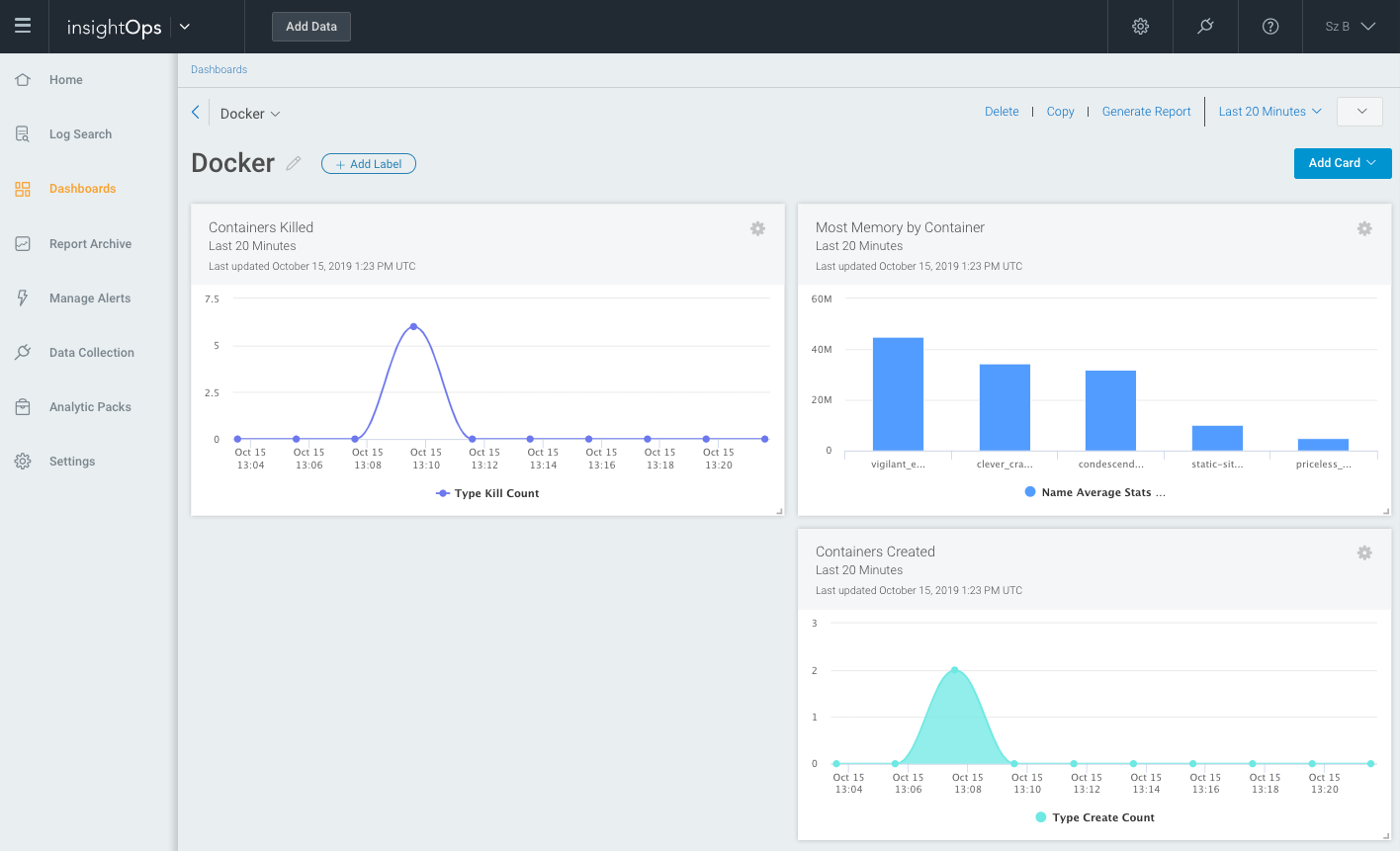
You can download the community pack created by InsightOps at Docker pack. The community pack comes with pre-defined out-of-the-box alerts and widgets to get you started.
Usage as a Container
The simplest way to forward all your container's log to the Rapid7 Insight Platform is to run this repository as a container, with:
docker run -v /var/run/docker.sock:/var/run/docker.sock \
           --read-only \
           --security-opt=no-new-privileges \
           rapid7/r7insight_docker \
           -t <TOKEN> \
           -r <REGION> \
           -j \
           -a host="$(uname -n)"
You can also use different tokens for logging, stats and events:
docker run -v /var/run/docker.sock:/var/run/docker.sock \
           --read-only \
           --security-opt=no-new-privileges \
           rapid7/r7insight_docker \
           -l <LOGSTOKEN> \
           -k <STATSTOKEN> \
           -e <EVENTSTOKEN> \
           -r <REGION> \
           -j \
           -a host="$(uname -n)"
You can supply log, stats and event tokens using environment variables:
INSIGHT_LOGSTOKEN: Log token for logs
INSIGHT_STATSTOKEN: Log token for stats
INSIGHT_EVENTSTOKEN: Log token for events
INSIGHT_TOKEN: Log token which is used for the above tokens if one is not provided. (You can only supply this token and it'll be used for logs, stats and events)
The --read-only docker flag specifies that the container file system will be read-only.
This is not a requirement but since currently there's no need for writing, it makes the container more secure.
The --security-opt=no-new-privileges docker flag sets a kernel bit which stops the process or its children
from gaining additional privileges via setuid or sgid.
Once again not required, but increases security.
You can pass the --no-stats flag if you do not want stats to be
published to the Rapid7 Insight Platform every second. You need this flag for Docker
version < 1.5.
You can pass the --no-logs flag if you do not want logs to be published to the Rapid7 Insight Platform.
You can pass the --no-dockerEvents flag if you do not want events to be
published to the Rapid7 Insight Platform.
The -i/--statsinterval <STATSINTERVAL> downsamples the logs sent to the Rapid7 Insight Platform. It collects samples and averages them before sending.
If you don't use the -a flag, a default value of host="$(uname -n)" will be added.
You can pass the --no-secure flag if you want your logs to be sent to the Insight Platform un-encrypted.
You can also filter the containers for which the logs/stats are forwarded with:
--matchByName REGEXP: forward logs/stats only for the containers whose name matches the given REGEXP.--matchByImage REGEXP: forward logs/stats only for the containers whose image matches the given REGEXP.--skipByName REGEXP: do not forward logs/stats for the containers whose name matches the given REGEXP.--skipByImage REGEXP: do not forward logs/stats for the containers whose image matches the given REGEXP.
Running container in a restricted environment.
Some environments(such as Google Compute Engine) does not allow to access the Docker socket without special privileges. You will get EACCES(Error: read EACCES) error if you try to run the container.
To run the container in such environments add --privileged to the docker run command.
Example:
docker run --privileged \
           -v /var/run/docker.sock:/var/run/docker.sock \
           --read-only \
           --security-opt=no-new-privileges \
           rapid7/r7insight_docker \
           -t <TOKEN> \
           -r <REGION> \
           -j \
           -a host="$(uname -n)"
Usage as a CLI
npm install r7insight_docker -gr7insight_docker -t TOKEN -r REGION -a host="$(uname -n)"
You have to specify TOKEN by passing -t TOKEN
You have to specify REGION by passing -r REGION. Region is mandatory.
You can also pass the -j switch if you log in JSON format, like
bunyan.
You can pass the --no-stats flag if you do not want stats to be
published to the Rapid7 Insight Platform every second.
You can pass the --no-logs flag if you do not want logs to be published to the Rapid7 Insight Platform.
You can pass the --no-dockerEvents flag if you do not want events to be
published to the Rapid7 Insight Platform.
The -a/--add flag allows to add fixed values to the data being
published. This follows the format 'name=value'.
The -i/--statsinterval downsamples the logs sent to the Rapid7 Insight Platform. It collects samples and averages them before sending.
You can also filter the containers for which the logs/stats are forwarded with:
--matchByName REGEXP: forward logs/stats only for the containers whose name matches the given REGEXP.--matchByImage REGEXP: forward logs/stats only for the containers whose image matches the given REGEXP.--skipByName REGEXP: do not forward logs/stats for the containers whose name matches the given REGEXP.--skipByImage REGEXP: do not forward logs/stats for the containers whose image matches the given REGEXP.
Embedded usage
Install it with: npm install r7insight_docker --save
Then, in your JS file:
const insight = require('r7insight_docker');

const logger = insight.utils.start({
  json: false, // or true to parse lines as JSON
  secure: true, // or false to connect over plain TCP
  region: "eu", // specify region
  token: process.env.TOKEN, // Insight Platform TOKEN
  newline: true, // Split on newline delimited entries
  stats: true, // disable stats if false
  add: null, // an object whose properties will be added

  // the following options limit the containers being matched
  // so we can avoid catching logs for unwanted containers
  matchByName: /hello/, // optional
  matchByImage: /matteocollina/, //optional
  skipByName: /.*pasteur.*/, //optional
  skipByImage: /.*dockerfile.*/ //optional
});

// logger is the source stream with all the
// log lines
setTimeout(function() {
  logger.destroy();
}, 5000);
Building a Docker repo from this repository
Using the plain Docker file
First clone this repository, then:
docker build -t r7insight_docker .
docker run -v /var/run/docker.sock:/var/run/docker.sock \
              --read-only \
              --security-opt=no-new-privileges \
              r7insight_docker \
              -t <TOKEN> \
              -r <REGION> \
              -j \
              -a host="$(uname -n)"
Using Make - the official nodejs buster image
export BUILD_TYPE=node-buster
make build
make test
make tag
Using Make - the alpine linux build (~42Mb)
export BUILD_TYPE=node-alpine
make build
make test
make tag
Pushing to your own Docker repository
After you've build, tested, tagged it locally
export DOCKER_REGISTRY_PREFIX=<your-dockerhub-user>/<your-image-name>
make push
Publishing your own node package
- Update package.json depending on your requirements
make publish
How it works
This module wraps four Docker APIs:
POST /containers/{id}/attach, to fetch the logsGET /containers/{id}/stats, to fetch the stats of the containerGET /containers/json, to detect the containers that are running when this module startsGET /events, to detect new containers that will start after the module has started
This module wraps docker-loghose and docker-stats to fetch the logs and the stats as a never ending stream of data.
All the originating requests are wrapped in a never-ending-stream.
License
MIT
Tag summary
Content type
Image
Digest
Size
68.9 MB
Last updated
over 4 years ago
docker pull rapid7/r7insight_docker