rebasehelper/webhooks repository overview
Welcome to rebase-helper


There are several steps that need to be done when rebasing a package. The goal of rebase-helper is to automate most of these steps.
How to get it running?
rebase-helper is packaged in Fedora, so you can just install it with dnf.
If you wish to use the latest codebase, consult installation instructions.
How to use it?
After installation, execute rebase-helper from a directory containing SPEC file, sources and patches (usually cloned dist-git repository).
Without any arguments or configuration rebase-helper will attempt to determine the latest upstream version automatically. If that fails, or if you wish to rebase to some different version, you can specify it explicitly as an argument:
$ rebase-helper 3.1.10
or you can pass source tarball filename instead:
$ rebase-helper foo-4.2.tar.gz
For complete CLI reference see usage.
Alternatively, you can run rebase-helper in a container:
$ docker run -it -e PACKAGE=foo rebasehelper/rebase-helper:latest
See docker reference for more information.
What do I get from it?
rebase-helper always creates rebase-helper-results directory containing the following items:
| Path | Description |
|---|---|
| report.txt | summary report with all important information |
| changes.patch | diff against original files, directly applicable to dist-git repo |
| logs/ | log files of various verbosity levels |
| rebased-sources/ | git repository with all modified files |
| checkers/ | reports from individual checkers that were run |
| old-build/ | logs and results of old (original) version build |
| new-build/ | logs and results of new (rebased) version build |
How does it work?
The following steps describe a rebase process:
-
Preparation
- rebase-helper-workspace and rebase-helper-results directories are created
- original SPEC file is copied to rebase-helper-results/rebased-sources directory and its Version tag is modified
-
Getting sources
- old and new source tarballs are downloaded and extracted to rebase-helper-workspace directory
- old sources are downloaded from lookaside cache if possible
-
Downstream patches
- new git repository is initialized and the old sources are extracted and commited
- each downstream patch is applied and changes introduced by it are commited
- new sources are extracted and added as a remote repository
git-rebaseis used to rebase the commits on top of new sources- original patches are modified/deleted accordingly
- resulting files are stored in rebase-helper-results/rebased-sources
- diff against original files is saved to rebase-helper-results/changes.patch
-
Build
- old and new source RPMs are created and built with selected build tool
- old SRPM and RPMs can also be downloaded from Koji to speed up the rebase
-
Comparison
- multiple checker tools are run against both sets of packages and their output is stored in rebase-helper-results/checkers directory
-
Cleanup
- rebase-helper-workspace directory is removed
Video presentation
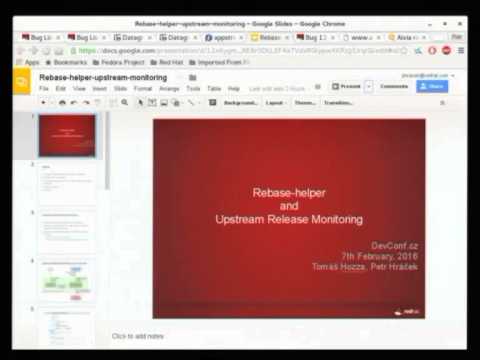
At DevConf.cz 2016, Tomáš Hozza, Petr Hráček presented on rebase-helper.
Tag summary
Content type
Image
Digest
Size
336.8 MB
Last updated
about 7 years ago
docker pull rebasehelper/webhooks