robinn/phpcacheadmin
Web GUI for managing Redis, Memcached, APCu, OPCache and Realpath with data management.
50K+
robinn/phpcacheadmin repository overview
https://github.com/RobiNN1/phpCacheAdmin

Web GUI for managing Redis, Valkey, KeyDB, Memcached, APCu, OPCache, and Realpath with data management.
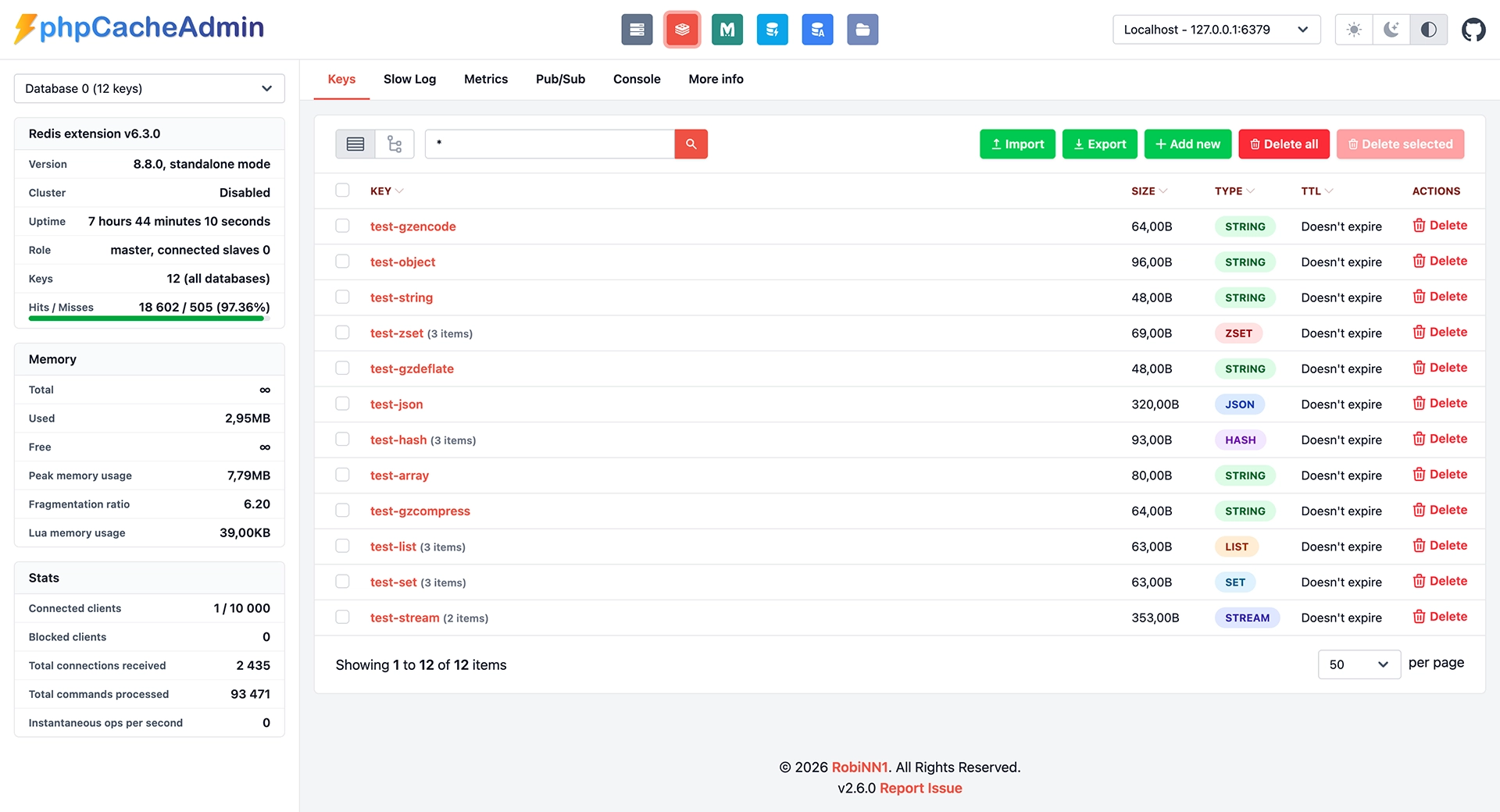

Features
General
- Clean, responsive interface with a Dark Mode.
- Switch between multiple configured servers for Redis, Memcached.
- Table or tree view of the key list, grouped by a configurable separator.
- Back up and restore your data.
- Quickly find keys across your cache.
- View any key's details in a modal without leaving the list.
- View a value as formatted, raw, or a hex dump.
- Optional login page with basic authentication (enabled by defining users in
authusers). - Read-only mode that hides and blocks everything destructive.
- No composer required to run.
Redis
- Works with Valkey and KeyDB as well.
- Works with both phpredis and Predis clients.
- View, add, edit, and delete keys. Supports all Redis data types, including vector sets.
- Search within a key's sub-items (hash fields, set/list/sorted set members).
- Stream consumer groups with their consumers, pending entries and lag.
- Analysis of the keyspace, with recommendations and the key size distribution counted by the server itself.
- Latency with the events recorded by the latency monitor, per-command percentiles and LATENCY / MEMORY DOCTOR advice.
- Clients list with the option to disconnect any of them.
- Profiler to watch commands as they run, live, via MONITOR.
- Console for running Redis commands interactively.
- PUB/SUB support to browse channels, subscribe and publish messages.
- Metrics with health checks for memory, hit rate, evictions, clients, persistence and replication.
- Cluster and Sentinel support.
- Supports ACL.
- Detailed server statistics including command calls, memory usage, uptime, connected clients, and general info.
- View the Redis slowlog to debug performance issues.
- Supports both SCAN and KEYS commands for retrieving keys.
Memcached
- Uses a custom client, so no memcache(d) extension is required.
- View, add, edit, and delete keys.
- Analysis of the keyspace, with the item size distribution when the server runs with
-o track_sizes. - Watcher to see what the server does with each key as it happens - reads, writes, evictions, deletions and connections.
- Connections list with the state and idle time of each client.
- Console for running Memcached commands interactively.
- Metrics with health checks.
- Server Stats including uptime, memory usage, connections, and more.
- Slabs & Items info.
- Commands Stats.
PHP Caches
- APCu:
- View, edit, and delete user-cached entries.
- View cache information and memory usage statistics.
- Analysis of the cache, with a memory map of each shared memory segment.
- Health checks.
- OPcache:
- View and invalidate cached scripts.
- Get statistics on memory usage, hit rates, and cached keys.
- Treemap visualization of cached scripts by memory usage.
- Preload list of the files kept in memory for the life of the server.
- Warmup that compiles a whole directory into the cache.
- Health checks.
- Realpath Cache:
- View and clear PHP's realpath cache entries.
- Health checks for the cache size, expired entries and the TTL.
There is also a Server dashboard for a quick look at the machine phpCacheAdmin runs on - PHP version and
configuration, loaded extensions, phpinfo(), and CPU, RAM and disk usage.
Access
There is no authentication until you define users in PCA_AUTHUSERS, so anyone who can open the page can also read,
change and delete everything in the configured servers. A published port is reachable by anyone who can reach the
host, so keep it on 127.0.0.1 as in the examples below, or turn the login page on. Setting PCA_READONLY leaves
only the read-only parts of the dashboards, and PCA_CONSOLE=false removes the Redis and Memcached consoles.
Docker
Run with a single command:
docker run -p 127.0.0.1:8080:80 -d --name phpcacheadmin -e "PCA_REDIS_0_HOST=redis_host" -e "PCA_REDIS_0_PORT=6379" -e "PCA_MEMCACHED_0_HOST=memcached_host" -e "PCA_MEMCACHED_0_PORT=11211" robinn/phpcacheadmin
Or use it in docker-compose.yml
services:
  phpcacheadmin:
    image: robinn/phpcacheadmin
    ports:
      - "127.0.0.1:8080:80"
    #volumes:
    # If you want to use config.php instead of ENV variables
    #  - "./config.php:/var/www/html/config.php"
    environment:
      - PCA_REDIS_0_HOST=redis
      - PCA_REDIS_0_PORT=6379
      - PCA_MEMCACHED_0_HOST=memcached
      - PCA_MEMCACHED_0_PORT=11211
    depends_on:
      - redis
      - memcached
  redis:
    image: redis:8-alpine
  memcached:
    image: memcached:alpine
Both examples publish the port to 127.0.0.1, so the dashboard is reachable from that machine only - through an SSH
tunnel from anywhere else. Drop the address (-p 8080:80) to open it to the network, and turn the login page on when
you do:
environment:
  - PCA_AUTHUSERS={"admin":"your-password"}
The password can also be a password_hash() hash. In a compose file every $ in it has to be written as $$,
otherwise compose treats it as a variable.
Cronjob
You can add these links to your cronjob to collect metrics when the dashboard is not open:
Redis https://example.com/phpCacheAdmin/?dashboard=redis&server=0&ajax&metrics
Memcached https://example.com/phpCacheAdmin/?dashboard=memcached&server=0&ajax&metrics
server=0is the default server ID.
Metrics are collected whenever this link is refreshed, so you can set any time in the cronjob.
If you have authentication enabled, set PCA_AUTHTOKEN and append &token=your-secret-token
to the cronjob URL so it can collect metrics without a login session.
Environment variables
All keys from the config file are supported ENV variables,
they just must start with PCA_ prefix.
Options with an array can be set using "dot notation" but use _ instead of a dot.
Or you can even use JSON (e.g., Redis SSL option).
Redis:
PCA_REDISCLIENTredisorpredis. Auto-detected when not set.PCA_REDIS_0_NAMEThe server name (optional).PCA_REDIS_0_HOSTOptional when a path or nodes is specified.PCA_REDIS_0_NODESList of cluster nodes. You can set value as JSON["127.0.0.1:7000","127.0.0.1:7001","127.0.0.1:7002"].PCA_REDIS_0_SENTINELSList of Sentinels, replaces the host/port when set. You can set value as JSON["127.0.0.1:26379","127.0.0.1:26380","127.0.0.1:26381"].PCA_REDIS_0_SENTINELMASTERName of the monitored master (optional). Defaultmymaster.PCA_REDIS_0_SENTINELPASSWORDPassword of the Sentinels themselves, not of the master (optional).PCA_REDIS_0_PORTOptional when the default port is used.PCA_REDIS_0_SCHEMEConnection scheme (optional). If you need a TLS connection, set it totls.PCA_REDIS_0_SSLSSL options for TLS. Requires Redis >= 6.0 (optional). You can set value as JSON{"cafile":"private.pem","verify_peer":true}.PCA_REDIS_0_DATABASEDefault database (optional).PCA_REDIS_0_USERNAMEACL - requires Redis >= 6.0 (optional).PCA_REDIS_0_PASSWORDOptional.PCA_REDIS_0_AUTHFILEFile with a password, e.g., Docker secrets (optional).PCA_REDIS_0_PATHUnix domain socket (optional).PCA_REDIS_0_DATABASESNumber of databases, use this if the CONFIG command is disabled (optional).PCA_REDIS_0_SCANTHRESHOLDUse SCAN automatically instead of KEYS when the database has more keys than this, 1000 keys are retrieved (optional). Default 100_000.PCA_REDIS_0_SCANSIZEAlways use SCAN and retrieve at most this many keys, regardless of the threshold (optional).PCA_REDIS_0_SEPARATORSeparator for the tree view (optional).
Memcached:
PCA_MEMCACHED_0_NAMEThe server name (optional).PCA_MEMCACHED_0_HOSTOptional when a path is specified.PCA_MEMCACHED_0_PORTOptional when the default port is used.PCA_MEMCACHED_0_PATHUnix domain socket (optional).PCA_MEMCACHED_0_SEPARATORSeparator for the tree view (optional).PCA_MEMCACHED_0_EXTENSIONEnable the Memcached extension only for get and set operations (optional).
Other:
PCA_AUTHUSERSUsers for the login page as JSON, e.g.{"admin":"your-password"}. Auth is off while it is empty.PCA_AUTHTOKENToken for the metrics cronjob.PCA_READONLYSet it totrueto block every destructive action (optional).PCA_CONSOLESet it tofalseto remove the Redis and Memcached consoles (optional).PCA_PHP_MEMORY_LIMITIn case you need to increase the PHP memory limit in Docker.PCA_NGINX_PORTIn case you need to change NGINX port in Docker.
Open the config file for more info.
To add another server, add the same environment variables, but change
0to1(2for the third server and so on).
.env files
You can keep these variables in a .env file instead of exporting them in the shell.
This requires vlucas/phpdotenv:
composer require vlucas/phpdotenv
Copy .env.example to .env and adjust the values.
The following files are loaded automatically (in order of precedence, the more specific file wins):
.env.{environment}.local.env.{environment}.env.local.env
{environment} comes from the PCA_ENV (or APP_ENV) variable, e.g., PCA_ENV=development also loads .env.development.
This lets you keep committed defaults in .env and override them locally in .env.local, which is git-ignored.
Real environment variables (e.g., set by Docker) always take precedence over the values in .env files,
so you can still override anything at runtime.
Requirements
- Redis server >= 4.0, or Valkey / KeyDB
- Memcached server >= 1.4.31. SASL is not supported because there is no way to get the keys
It is not necessary to have all dashboards enabled.
Tag summary
Content type
Image
Digest
sha256:8181b78cb…
Size
15.2 MB
Last updated
29 days ago
docker pull robinn/phpcacheadmin