subfuzion/voter repository overview
Docker Voting App (Node.js version)
License
The Voting App is open source and free for any use in compliance with the terms of the MIT License.
Build Status
| Service | Docker Image | Build Status |
|---|---|---|
| API | subfuzion/vote-api |  |
| Worker | subfuzion/vote-worker |  |
| Auditor | subfuzion/vote-auditor |  |
| Database | Mongo |  |
| Queue | Redis |  |
| Node.js Packages | npm | Build Status |
|---|---|---|
| @subfuzion/database |  |  |
| @subfuzion/queue |  | |
Quick Start
Get Docker for free from the Docker Store. This app will work with versions from either the Stable or the Edge channels.
If you're using Docker for Windows on Windows 10 pro or later, you must also switch to Linux containers.
Run in this directory:
$ docker-compose up
You can also run it on a Docker Swarm. If you haven't initialized one yet, run:
$ docker swarm init
Once you have your swarm, then run:
$ docker stack deploy --compose-file docker-stack.yml vote
About the Voting App
This app is based on the original Docker Example Voting App.
The original app is a great demonstration of how Docker can be used to containerize any process of a modern application regardless of the programming language used and runtime environment needed for each one. From a devops perspective, this is a compelling example of Docker's benefits.
However, if you are a developer who is also interested in hacking on the application a bit to experiment with it as well as to extend your knowledge around Docker, then the use of so many different languages can pose a slight barrier. This version of the app has been developed to support an introductory course on Docker and is meant to be slighly easier to hack on for just that reason.
It's hard to pick a single language that will please everyone. The decision was made to settle on Node.js due to its popularity for API development and because of the number of programmers who have had some exposure to JavaScript.
While JavaScript has its quirks, the code for the various packages in this example are written using
the latest EcmaScript support that is available in LTS (8.0+) and later versions of Node (See
node.green). In particular, the use of
async functions
should make control flow somewhat easier to follow for developers not as familiar with Node asynchronous
callback conventions.
As modest as the app is in terms of actual functionality (it only supports casting votes and querying the vote tally), it has nevertheless been designed to reflect principles of modern 12-Factor Apps well suited to showcasing Docker's benefits.
Goals
The first goal is to introduce basic Docker concepts, so the initial instructions reflect that. Subsequent goals include introducing orchestration concepts (such as Docker Swarm mode and Kubernetes, and then refactoring the application architecture to explore evolving Cloud-native paradigms. Real world concerns, such as monitoring, rolling updates, etc., will also be introduced.
Introduction to Docker
The app will be used for an introductory course called Software Containerization with Docker for Developers. The course will be offered through the UC Davis Extension online program, available on Coursera sometime in spring of 2018.
See the wiki for more detail about the course modules.
Application Architecture
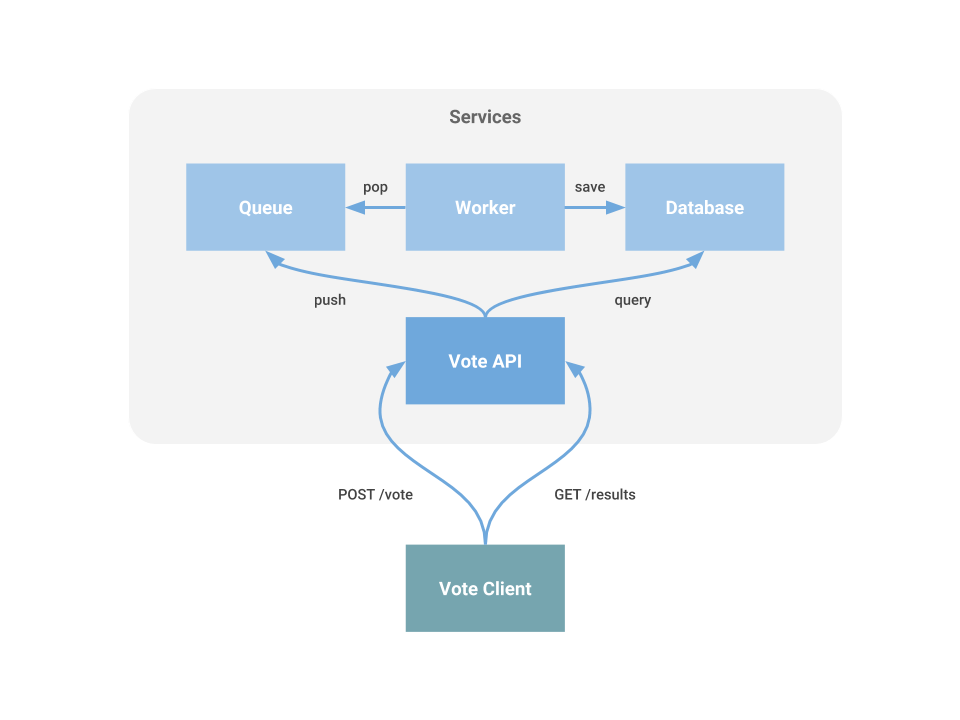
The application consists of the following:
- Vote Client - (
voter) the command-line application used to cast votes and query voting results. - Vote API - (
vote) the service that provides a REST API for casting votes and retrieving vote tallies. Thevoterapplication is the client that uses this API. When a vote is posted to the API, the service pushes it to a queue for subsequent, asynchronous processing. When a request is made for vote results, the service submits a query to a database where votes are ultimately stored by a worker processing the queue. - Worker - a background service that watches a queue for votes and stores them in a database. The worker represents a typical service component designed to scale as needed to handle various asynchronous processing tasks, typically pulled from a queue, so that the main service doesn't get bogged down handling requests.
- Queue - the message queue service that allows the vote api service to post votes without slowing down to do any special processing or waiting for a database to save votes. The queue is an in-memory data store (using Redis) that enhances performance by not requiring the vote service to wait on the database since database operations that involve disk I/O are much slower; consequently, the vote service is ready to continue to accept new API requests faster. Redis (and similar tools) are typical components of many real-world applications that require message queue, publish-subscribe, key-value storage, or caching support.
- Database - the database service (using MongoDB) for structured data storage and query support. One or more types of database are typical service components of most real world applications.
Launching the app
The following sequence describes how to start the application manually. We will
also cover starting it using docker-compose. We will also cover orchestration
using Docker Swarm mode and
Kubernetes.
Create a bridge network
Create a bridge network that will be shared by the services for communication with each other:
$ docker network create -d bridge bridgenet
Start a MongoDB container
MongoDB is a NoSQL database that we will use for storing votes. There is already an existing image that we can use:
$ docker run -d --network bridgenet --name database mongo
Start a Redis container
Redis provides a fast in-memory data store that we will use as a queue. Votes will be pushed to the queue, where workers will dequeue them asynchronously for saving to the MongoDB database for subsquent query processing.
Like, MongoDB, there is already an existing image that we can use:
$ docker run \
    --detach \
    --name=queue \
    --network=bridgenet \
    --health-cmd='[ $(redis-cli ping) = "PONG" ] || exit 1' \
    --health-timeout=5s \
    --health-retries=5 \
    --health-interval=5s \
    redis
or as one line:
$ docker run --detach --name=queue --network=bridgenet --health-cmd='[ $(redis-cli ping) = "PONG" ] || exit 1' --health-timeout=5s --health-retries=5 --health-interval=5s redis
Start a Vote Worker container
A vote worker pulls votes from the queue and saves them to the database for subsequent query processing.
You will need to build the image first:
$ cd worker
$ docker build -t worker .
Then you can start it:
$ docker run -d --network=bridgenet --name=worker worker
Start a Vote API container
The vote service provides the API that clients will use to submit votes and fetch
voting tally results. The vote service receives votes that it then pushes to the
queue (where they will subsequently pulled by workers and saved to the database),
and it also queries the database to tally the votes.
You will need to build the image first:
$ cd vote
$ docker build -t vote .
Then you can start it:
$ docker run -d --network=bridgenet --name=vote vote
Run a Vote client container
The vote app is a terminal program that you run to cast votes and fetch the
voting results.
You will need to build the image first:
$ cd voter
$ docker build -t voter .
Then you can start it:
$ docker run -it --rm --network=bridgenet -e=VOTE_API_HOST=vote --name=voter voter <cmd>
where <cmd> is either vote or results (if you don't enter any command,
then usage help will be printed to the terminal).
Run the assessor
The assessor will be used for evaluating the performance of the Voting App
running under Docker as part of course verification, primarily by monitoring
the logs of each service for patterns that must be matched to indicate success.
Once implemented, the assessor will produce a report when it completes an
evaluation or when the evaluation times out.
See here for instructions on running an assessment for the final project.
Tag summary
Content type
Image
Digest
Size
18.8 MB
Last updated
over 8 years ago
docker pull subfuzion/voter