tarent/loginsrv
JWT login microservice with plugable backends such as OAuth2, Github, htpasswd, osiam
100K+
tarent/loginsrv repository overview
loginsrv
loginsrv is a standalone minimalistic login server providing a JWT login for multiple login backends.



Abstract
Loginsrv provides a minimal endpoint for authentication. The login is performed against the providers and returned as Json Web Token. It can be used as:
- standalone microservice
- docker container
- golang library
- caddyserver plugin
NOTE: This Readme ist not updated automatically. For the latest version visit github.com/tarent/loginsrv
Supported Provider Backends
The following providers (login backends) are supported.
- Htpasswd
- OSIAM
- Simple (user/password pairs by configuration)
- Oauth2
- Github Login
- .. google and facebook will come soon ..
Questions
For questions and support please use the Gitter chat room.
Configuration and Startup
Config Options
Note for caddy users: Not all parameters are available in caddy. See the table for details. Incaddy, the parameter names can be also be used with _ in the names, e.g. cookie_http_only.
| Parameter | Type | Default | Caddy | Description |
|---|---|---|---|---|
| -cookie-domain | string | X | The optional domain parameter for the cookie | |
| -cookie-expiry | string | session | X | The expiry duration for the cookie, e.g. 2h or 3h30m |
| -cookie-http-only | boolean | true | X | Set the cookie with the http only flag |
| -cookie-name | string | "jwt_token" | X | The name of the jwt cookie |
| -github | value | X | Oauth config in the form: client_id=..,client_secret=..[,scope=..,][redirect_uri=..] | |
| -host | string | "localhost" | - | The host to listen on |
| -htpasswd | value | X | Htpasswd login backend opts: file=/path/to/pwdfile | |
| -jwt-expiry | go duration | 24h | X | The expiry duration for the jwt token, e.g. 2h or 3h30m |
| -jwt-secret | string | "random key" | X | The secret to sign the jwt token |
| -log-level | string | "info" | - | The log level |
| -login-path | string | "/login" | X | The path of the login resource |
| -logout-url | string | X | The url or path to redirect after logout | |
| -osiam | value | X | OSIAM login backend opts: endpoint=..,client_id=..,client_secret=.. | |
| -port | string | "6789" | - | The port to listen on |
| -simple | value | X | Simple login backend opts: user1=password,user2=password,.. | |
| -success-url | string | "/" | X | The url to redirect after login |
| -template | string | X | An alternative template for the login form | |
| -text-logging | boolean | true | - | Log in text format instead of json |
Environment Variables
All of the above Config Options can also be applied as environment variable, where the name is written in the way: LOGINSRV_OPTION_NAME.
So e.g. jwt-secret can be set by environment variable LOGINSRV_JWT_SECRET.
Startup examples
The simplest way to use loginsrv is by the provided docker container. E.g. configured with the simple provider:
$ docker run -d -p 80:80 tarent/loginsrv -jwt-secret my_secret -simple bob=secret

$ curl --data "username=bob&password=secret" 127.0.0.1/login
eyJhbGciOiJIUzUxMiIsInR5cCI6IkpXVCJ9.eyJzdWIiOiJib2IifQ.uWoJkSXTLA_RvfLKe12pb4CyxQNxe5_Ovw-N5wfQwkzXz2enbhA9JZf8MmTp9n-TTDcWdY3Fd1SA72_M20G9lQ
The same configuration could be written with environment variables this way:
$ docker run -d -p 80:80 -e LOGINSRV_JWT_SECRET=my_secret -e LOGINSRV_BACKEND=provider=simple,bob=secret tarent/loginsrv
API
GET /login
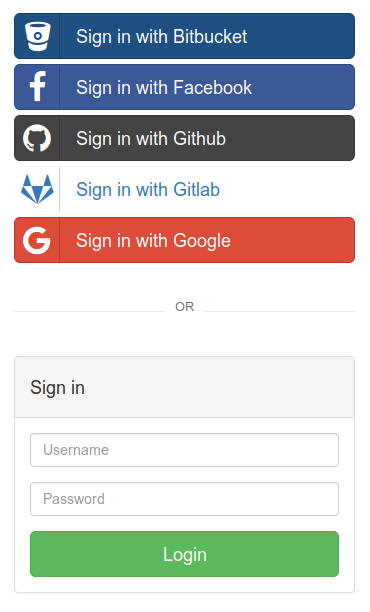
Returns a simple bootstrap styled login form.
The returned html follows the ui composition conventions from (lib-compose)[https://github.com/tarent/lib-compose], so it can be embedded into an existing layout.
GET /login/
Starts the Oauth Web Flow with the configured provider. E.g. GET /login/github redirects to the github login form.
POST /login
Perfoms the login and returns the JWT. Depending on the content-type, and parameters a classical JSON-Rest or a redirect can be performed.
Runtime Parameters
| Parameter-Type | Parameter | Description | |
|---|---|---|---|
| Http-Header | Accept: text/html | Set the JWT-Token as Cookie 'jwt_token'. | default |
| Http-Header | Accept: application/jwt | Returns the JWT-Token within the body. No Cookie is set. | |
| Http-Header | Content-Type: application/x-www-form-urlencoded | Expect the credentials as form encoded parameters. | default |
| Http-Header | Content-Type: application/json | Take the credentials from the provided json object. | |
| Post-Parameter | username | The username | |
| Post-Parameter | password | The password |
Possible Return Codes
| Code | Meaning | Description |
|---|---|---|
| 200 | OK | Successfully authenticated |
| 403 | Forbidden | The Credentials are wrong |
| 400 | Bad Request | Missing parameters |
| 500 | Internal Server Error | Internal error, e.g. the login provider is not available or failed |
| 303 | See Other | Sets the JWT as a cookie, if the login succeeds and redirect to the urls provided in redirectSuccess or redirectError |
Hint: The status 401 Unauthorized is not used as a return code to not conflict with an Http BasicAuth Authentication.
DELETE /login
Deletes the JWT Cookie.
For simple usage in web applications, this can also be called by GET|POST /login?logout=true
API Examples
Example:
Default is to return the token as Content-Type application/jwt within the body.
curl -i --data "username=bob&password=secret" http://127.0.0.1:6789/login
HTTP/1.1 200 OK
Content-Type: application/jwt
Date: Mon, 14 Nov 2016 21:35:42 GMT
Content-Length: 100

eyJhbGciOiJIUzI1NiIsInR5cCI6IkpXVCJ9.eyJzdWIiOiJib2IifQ.-51G5JQmpJleARHp8rIljBczPFanWT93d_N_7LQGUXU
Example: Credentials as JSON
The Credentials also could be send as JSON encoded.
curl -i -H 'Content-Type: application/json'  --data '{"username": "bob", "password": "secret"}' http://127.0.0.1:6789/login
HTTP/1.1 200 OK
Content-Type: application/jwt
Date: Mon, 14 Nov 2016 21:35:42 GMT
Content-Length: 100

eyJhbGciOiJIUzI1NiIsInR5cCI6IkpXVCJ9.eyJzdWIiOiJib2IifQ.-51G5JQmpJleARHp8rIljBczPFanWT93d_N_7LQGUXU
Example: web based flow with 'Accept: text/html'
Sets the jwt token as cookie and redirects to a web page.
curl -i -H 'Accept: text/html' --data "username=bob&password=secret" http://127.0.0.1:6789/login
HTTP/1.1 303 See Other
Location: /
Set-Cookie: jwt_token=eyJhbGciOiJIUzI1NiIsInR5cCI6IkpXVCJ9.eyJzdWIiOiJib2IifQ.-51G5JQmpJleARHp8rIljBczPFanWT93d_N_7LQGUXU; HttpOnly
The JWT Token
Depending on the provider, the token may look as follows:
{
  "sub": "smancke",
  "picture": "https://avatars2.githubusercontent.com/u/4291379?v=3",
  "name": "Sebastian Mancke",
  "email": "[email protected]",
  "origin": "github"
}
Provider Backends
Htpasswd
Authentication against htpasswd file. MD5, SHA1 and Bcrypt are supported. But we recommend to only use bcrypt for security reasons (e.g. htpasswd -B -C 15).
Parameters for the provider:
| Parameter-Name | Description |
|---|---|
| file | Path to the password file |
Example:
loginsrv -backend 'provider=htpasswd,file=users
OSIAM
OSIAM is a secure identity management solution providing REST based services for authentication and authorization. It implements the multplie OAuth2 flows, as well as SCIM for managing the user data.
To start loginsrv against the default osiam configuration on the same machine, use the following example.
loginsrv --jwt-secret=jwtsecret --text-logging -backend 'provider=osiam,endpoint=http://localhost:8080,clientId=example-client,clientSecret=secret'
Then go to http://127.0.0.1:6789/login and login with admin/koala.
Simple
Simple is a demo provider for testing only. It holds a user/password table in memory.
Example
loginsrv -backend provider=simple,bob=secret
Oauth2
The Oauth Web Flow (aka 3-leged-Oauth flow) is also supported. Currently the following oauth Provider is supported:
- github
An Oauth Provider supports the following parameters:
| Parameter-Name | Description |
|---|---|
| client_id | Oauth Client ID |
| client_secret | Oauth Client Secret |
| scope | Space separated scope List (optional) |
| redirect_uri | Alternative Redirect URI (optional) |
When configuring the oauth parameters at your external oauth provider, a redirect uri has to be supplied. This redirect uri has to point to the path /login/<provider>.
If not supplied, the oauth redirect uri is caclulated out of the current url. This should work in most cases and should even work
if loginsrv is routed through a reverse proxy, if the headers X-Forwarded-Host and X-Forwarded-Proto are set correctly.
Github Startup Example
$ docker run -p 80:80 tarent/loginsrv -github client_id=xxx,client_secret=yyy
Templating
A custom template can be supplied by the parameter template.
You can find the original template in login/login_form.go.
The templating uses the golang build in template language. A short intro can be found here.
When you specify a custom template, only the layout of the original template is replaced. The partials of the original are still loaded into the template context and can be used by your template. So a minimal unstyled login template could look like this:
<!DOCTYPE html>
<html>
  <head>
      <!-- your styles -->
  <head>
  <body>
      <!-- your header -->

      {{ if .Error}}
        <div class="alert alert-danger" role="alert">
          <strong>Internal Error. </strong> Please try again later.
        </div>
      {{end}}

      {{if .Authenticated}}

         {{template "userInfo" . }}

      {{else}}

        {{template "login" . }}

      {{end}}

      <!-- your footer -->
</body>
</html>
Tag summary
Content type
Image
Digest
Size
8.6 MB
Last updated
over 6 years ago
docker pull tarent/loginsrv