ypno/arlo-camera-streamer-rs
A Rust daemon that bridges battery-powered Arlo cameras to a 24/7 NVR via RTSP
644
ypno/arlo-camera-streamer-rs repository overview
arlo-camera-streamer
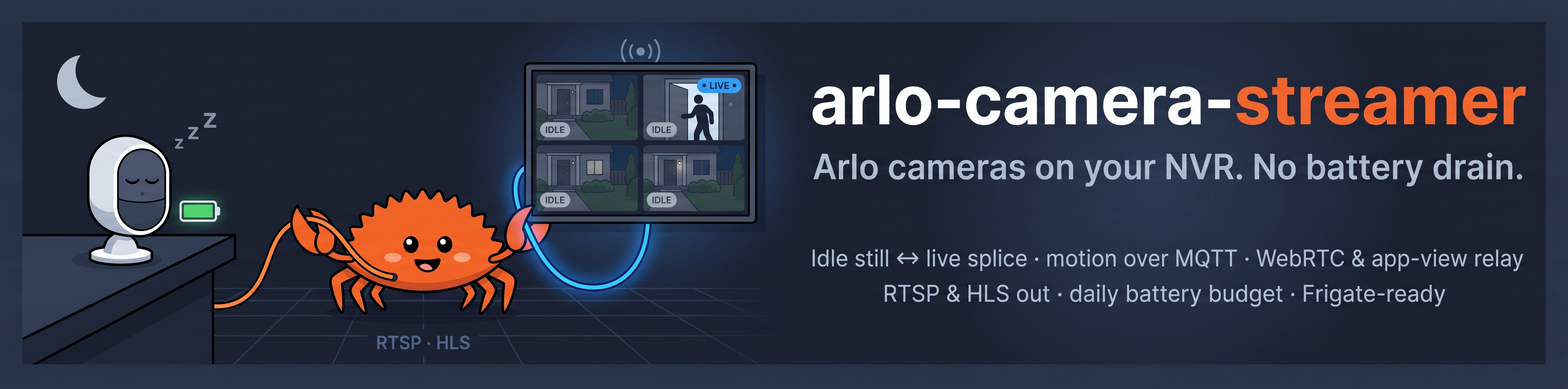
A Rust daemon that bridges battery-powered Arlo cameras to a 24/7 NVR (Frigate, ZoneMinder, Shinobi, Home Assistant) over RTSP, and optionally HLS, without draining the camera battery.
An NVR expects a continuous stream. Arlo battery cameras sleep by design; a continuous pull would flatten them in a day. This daemon decouples the two: the RTSP output is always up and shows a still frame (the camera's last snapshot) while the camera sleeps, and splices the camera's real video in, on the same connection, when Arlo reports motion or when you open a live view in the Arlo app. Your NVR sees one uninterrupted stream per camera.
| Phase | Your NVR sees | The camera |
|---|---|---|
| Idle | Last snapshot with a standby overlay, 1 fps | Sleeping |
| Motion | The live H.264 feed, until the motion stops plus a debounce | Awake |
| Viewed in the Arlo app | The app's own stream, picture and sound | Awake, because of you |
| Daily budget spent | Back to the idle frame | Sleeping, protected |
Source, full documentation, changelog and issues: https://github.com/YpNo/arlo-camera-streamer-rs
Tags
| Tag | Meaning |
|---|---|
v<version> (e.g. v0.1.0) | A release. Pin this one. |
latest | The newest release. |
sha-<commit> | The exact commit a release was built from. |
Every tag is also published to GitHub's registry as
ghcr.io/ypno/arlo-camera-streamer-rs, byte for byte the same image. Each
digest is scanned with Trivy before it is tagged and carries SLSA provenance
and an SPDX SBOM. Platform: linux/amd64 (linux/arm64 is on the roadmap).
What is in the image
- The
arlo-camera-streamerbinary, statically configured by one TOML file. - GStreamer 1.22 with the plugins the pipelines need: base, good, bad, ugly,
libav,
gst-rtsp-server, libnice for WebRTC, VA-API drivers for Intel/AMD hardware encoding. tinias PID 1. No shell tools: the health check is the binary's ownhealthchecksubcommand.- Runs as uid/gid
10001, non-root, with aHEALTHCHECKbuilt in.
Quick start
1. Configuration. Copy the example and fill in the [arlo] section
(account email, the name of the env var holding the password, the second
factor). Secrets never go in the file.
https://github.com/YpNo/arlo-camera-streamer-rs/blob/main/config/streamer.example.toml
2. State directory. The session token and the idle thumbnails live under
/var/lib/arlo-streamer. On a bind mount it must belong to the image's user:
sudo mkdir -p /var/lib/arlo-streamer && sudo chown -R 10001:10001 /var/lib/arlo-streamer
3. First login and device ids. One interactive run signs in, completes
the second-factor pairing and prints a ready-to-paste [[cameras]] block per
camera. Keep the same state volume for the daemon afterwards; -it matters
only when the one-time code is typed on stdin.
docker run --rm -it -e ARLO_PASSWORD -e ARLO_IMAP_PASSWORD \
  -v /etc/arlo-streamer:/etc/arlo-streamer:ro \
  -v /var/lib/arlo-streamer:/var/lib/arlo-streamer \
  ypno/arlo-camera-streamer-rs:v0.1.0 list-devices --config /etc/arlo-streamer/streamer.toml
4. Run the daemon.
docker run -d --name arlo-camera-streamer --restart on-failure \
  -p 8554:8554 \
  -v /etc/arlo-streamer:/etc/arlo-streamer:ro \
  -v /var/lib/arlo-streamer:/var/lib/arlo-streamer \
  -e ARLO_PASSWORD -e ARLO_IMAP_PASSWORD -e STREAMER_ADMIN_TOKEN \
  ypno/arlo-camera-streamer-rs:v0.1.0
5. Watch. rtsp://<host>:8554/<stream_name> in VLC or as a Frigate input.
The idle frame shows at once; walk in front of the camera and the picture
goes live within a few seconds.
Environment variables
| Variable | Purpose |
|---|---|
ARLO_PASSWORD (or the name set in arlo.password_env) | Required. Arlo cloud password. |
ARLO_IMAP_PASSWORD (or the name set in arlo.mfa.password_env) | IMAP password, for the email second factor read from a mailbox. |
STREAMER_ADMIN_TOKEN | Required by the daemon. Bearer token for the /admin/* API, 16 bytes or more (openssl rand -hex 32). |
RUST_LOG | Optional log filter. The image sets info,arlo_camera_streamer=info. |
Ports
| Port | Purpose |
|---|---|
8554/tcp | RTSP output, one mount per camera. |
9090/tcp | /metrics (Prometheus), /healthz, /readyz. |
9091/tcp | /admin/* (bearer token): state, manual wake, force idle. |
The metrics and admin listeners bind 127.0.0.1 inside the container by
default, so publishing their ports alone exposes nothing. To reach them from
outside, set output.metrics_bind = "0.0.0.0:9090" and
output.admin_bind = "0.0.0.0:9091" in the config, and keep the admin port
off any untrusted network.
Hardware encoding
The daemon re-encodes one H.264 stream per camera. With the default
video_encoder = "auto" it probes the host at start and takes the first
backend that works; give the container the device:
| Hardware | Add to docker run |
|---|---|
| Intel / AMD GPU | --device /dev/dri |
| Raspberry Pi 4 / Zero 2 / CM4 | --device /dev/video11 |
| NVIDIA | --gpus all (NVIDIA container toolkit) |
| none | nothing: x264 in software, about 0.6 CPU core per connected camera |
HLS output
Set [output.hls] dir = "/var/lib/arlo-streamer/hls" and the daemon writes
<dir>/<stream_name>/index.m3u8 plus segments, served by any static web
server. HLS keeps each camera's encoder running whenever the segmenter is
up.
Operational notes
- Disable the Arlo app's own motion recording for the cameras exposed here; Arlo's cloud recording competes with the live stream.
- Start with a
daily_live_budgetof 300 to 600 seconds per camera until you have measured the battery impact;0means no cap. - The process exits non-zero when it stops on its own (the Arlo event bus
ended, or a camera task failed) after releasing every live session: run it
under
--restart on-failure. - Logs go to stderr;
docker logsshows them. The project README documents everyRUST_LOGtarget and theGST_DEBUGcategories for the RTSP server.
Security
- Secrets come from environment variables only and are never logged; presigned URLs, session ids and tokens are redacted by design.
- Thumbnails are fetched over HTTPS only with timeouts and a size cap, and written owner-only beside the session cache.
- Report a vulnerability as described in https://github.com/YpNo/arlo-camera-streamer-rs/blob/main/SECURITY.md.
License
MIT. Not affiliated with Arlo Technologies; Arlo is a trademark of its owner.
Tag summary
Content type
Image
Digest
sha256:3ee606413…
Size
276.5 MB
Last updated
6 days ago
docker pull ypno/arlo-camera-streamer-rs